
Political essay
Evidence-Based Strategic Decision-Making for a Constitutional-Democratic Transition Movement
Important neutrality note: This paper treats constitutional monarchy, secular democracy, territorial integrity, equality before law, free elections and ballot-box legitimacy as the stated aims supplied by the commissioning user.
English article
Applying SMART objectives, PESTLE analysis, force-field analysis, stakeholder mapping and balanced scorecards to the Iranian transition debate
Date: 22 May 2026
Document type: Scientific-style policy and management paper
Important neutrality note: This paper treats constitutional monarchy, secular democracy, territorial integrity, equality before law, free elections and ballot-box legitimacy as the stated aims supplied by the commissioning user. It does not assert that any political faction has a superior democratic claim by default. Its purpose is methodological: to show how decisions within a transition-oriented civic movement can be tested against transparent, measurable and rights-compliant criteria.
Abstract
Political transition movements often fail not because their ultimate goals are unclear, but because daily decisions are made through emotion, factional memory, symbolic loyalty, revenge narratives or personal rivalry rather than disciplined governance. This paper proposes a structured decision-making architecture for Iranian civic activists who define their strategic objective as a transition from the Islamic Republic of Iran toward a secular, pluralist, rule-of-law order in which the final constitutional form, including any constitutional monarchy option, is determined by free and fair elections or a referendum. The paper integrates SMART objectives, PESTLE scanning, stakeholder analysis, Lewin-style force-field analysis, a legitimacy-risk gate, and balanced-scorecard monitoring. It also offers a stakeholder typology relevant to the pro-Pahlavi constitutional-democratic space: exile-era romantic royalists; pragmatic monarchists inside Iran or recently emigrated; defectors and former regime-adjacent actors; and non-monarchist democratic actors who may share transitional goals while disagreeing on final constitutional form. The core finding is procedural: movements seeking democratic legitimacy should measure every action by whether it increases unity, trust, non-violent mobilisation, defections from coercive structures, public legitimacy, legal accountability, and international credibility, while reducing factional revenge, collective guilt, misinformation and operational risk.
Keywords: Iran, democratic transition, constitutional monarchy, SMART goals, PESTLE, force-field analysis, stakeholder mapping, balanced scorecard, rule of law, transitional legitimacy.
Executive Summary
A transition movement needs a measurable strategic-management system, not only slogans, symbols or historic grievances.
SMART objectives define the destination; PESTLE defines the external environment; force-field analysis identifies drivers and blockers; balanced scorecards monitor whether decisions are moving the system toward the stated goal.
The central decision criterion should be: does this action measurably improve the probability of a legitimate, pluralist, rights-compliant and ballot-box-confirmed transition?
A movement that seeks secular democracy must not reproduce authoritarian habits in its own internal culture. Revenge rhetoric, collective guilt, glorification of repression and anti-pluralist language create strategic and moral risk.
Supporters of Crown Prince Reza Pahlavi contain diverse constituencies. Their differences are not merely ideological; they reflect different biographical histories, memories of 1979, exposure to Islamic Republic governance, fear of retribution, and different appetites for compromise.
The paper proposes a practical scoring model that can be applied to speeches, alliances, protests, media campaigns, policy documents, international lobbying, and dispute resolution.
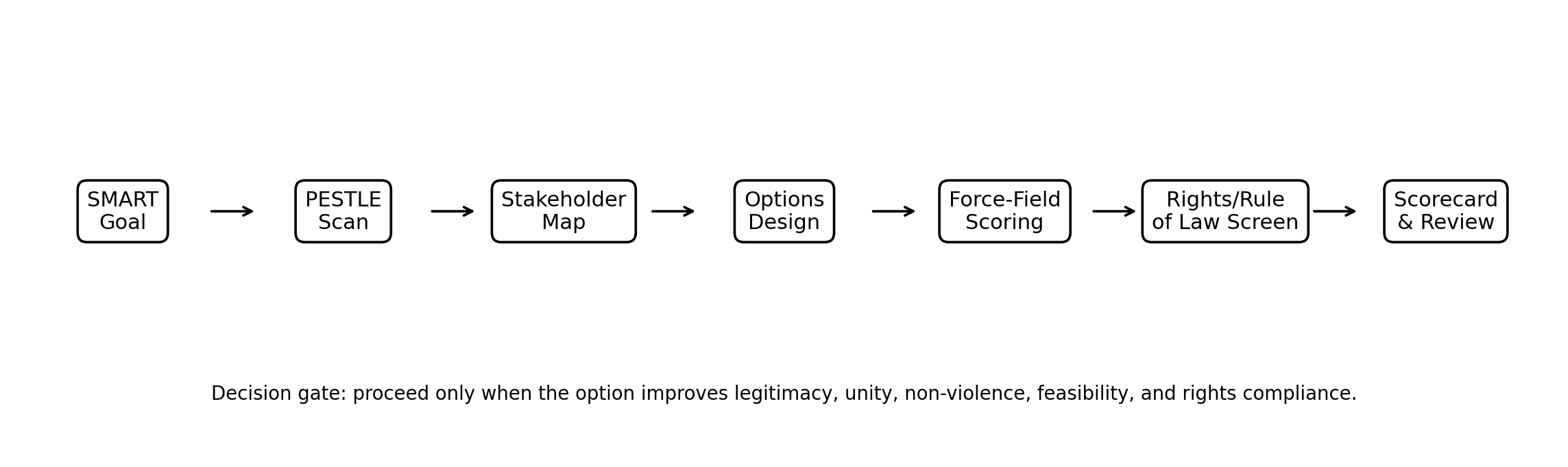
Figure 1. Integrated strategic decision pipeline.
1. Research Question and Scope
The research question is: how can a transition-oriented Iranian civic movement make decisions in a disciplined, transparent and measurable way so that its daily actions are aligned with its declared constitutional-democratic objective?
The paper uses a management-science lens rather than a purely ideological lens. It assumes that movements, like organisations, face resource constraints, stakeholder conflict, reputational risk, information asymmetry, coalition-management problems and performance-measurement failures. Therefore, a movement requires a decision architecture: a repeatable method for converting political goals into operational decisions and measurable outcomes.
The scope is deliberately procedural. It does not attempt to prove whether monarchy, republic or another constitutional form is inherently preferable. It treats the final state form as a question for free and fair public decision-making. This distinction is essential: a democratic transition movement may advocate constitutional monarchy, but its legitimacy depends on accepting that the final constitutional settlement belongs to citizens through the ballot box.
2. Normative and Empirical Baseline
The author-supplied normative baseline contains six principles: secular democracy; territorial integrity; equality before law; pluralism; free elections or referendum; and rule-of-law accountability rather than revenge. These principles are broadly consistent with recent public statements by Reza Pahlavi in which he described his role as maximising the chance for Iranians to decide through the ballot box and a referendum what secular democratic government should replace the current religious dictatorship (Council on Foreign Relations, 2025). Reuters reported that Pahlavi framed transition principles around territorial integrity, individual freedoms, equality of citizens and separation of religion and state, while also noting uncertainty about the level of support for monarchy inside Iran and the fragmentation of the opposition (Reuters, 2025).
The empirical baseline is also important. Freedom House characterises Iran as a system where ultimate power rests with the supreme leader and unelected institutions, and where elections fall short of democratic standards because unelected bodies disqualify candidates considered insufficiently loyal to the clerical establishment (Freedom House, 2026). Amnesty International reports severe human-rights violations, including repression during and after the 12-day armed conflict involving Iran and Israel, arbitrary detention, harassment and prosecution of people exercising human rights, and unlawful force against protesters (Amnesty International, 2026).
These sources justify a transition-analysis framework, but they do not eliminate uncertainty. A scientifically defensible paper must acknowledge that diaspora perceptions, public slogans and rally sizes do not automatically equal a verified national mandate. Therefore, all claims about legitimacy should be expressed as hypotheses requiring measurement, triangulation and ultimate confirmation through a free vote.
3. Methodological Framework
3.1 SMART as the Goal Discipline
SMART goal-setting was introduced in management literature by George T. Doran in 1981 as a way to write management goals and objectives that are specific, measurable, assignable, realistic and time-related; modern variants commonly use specific, measurable, achievable, relevant and time-bound (Doran, 1981; Bjerke & Renger, 2017). In a transition movement, SMART prevents vague activism from becoming performative activism.
SMART element | Political-transition interpretation | Example measurable indicator |
|---|---|---|
Specific | The desired outcome must be defined without ambiguity. | A written transition charter commits to secular democracy, territorial integrity, free referendum/election, equality before law and due process. |
Measurable | Progress must be observable through evidence. | Number of cross-ideological endorsements; reduction in hostile factional messaging; verified reach inside Iran; number of policy working groups with transparent membership. |
Achievable | Objectives must match resources and constraints. | The campaign does not promise immediate total transformation without institutional capacity, security planning or coalition buy-in. |
Relevant | Actions must advance the stated constitutional-democratic goal. | A media intervention is scored positively only if it improves legitimacy, unity, non-violence, rights compliance or organisational capacity. |
Time-bound | Objectives must have review dates and decision gates. | Quarterly review of coalition health, messaging discipline, risk indicators, engagement metrics and policy readiness. |
3.2 PESTLE as External Environment Scan
PESTLE analysis examines political, economic, social, technological, legal and environmental factors affecting an organisation or strategic situation. CIPD describes it as a strategic decision-making tool for understanding key external factors that influence organisations and senior managers (CIPD, 2026). In a transition movement, PESTLE helps distinguish controllable decisions from external constraints.
PESTLE domain | Iranian transition relevance | Key questions for decision-makers |
|---|---|---|
Political | Regime cohesion, opposition fragmentation, diaspora politics, international recognition, regional security. | Will the action increase broad legitimacy or deepen polarisation? Does it help democratic opposition coordination? |
Economic | Inflation, sanctions, unemployment, energy pressures, fiscal fragility, post-transition reconstruction. | Does the movement offer credible economic continuity and anti-chaos messaging? |
Social | Memory of 1979, trauma, exile identity, generational differences, fear of revenge, ethnic and religious diversity. | Does messaging reassure diverse groups and avoid collective guilt? |
Technological | Social media, censorship circumvention, cyber risk, surveillance, AI disinformation. | Is the information verified? Are activists and contacts protected from digital exposure? |
Legal | Human-rights law, transitional justice, constitutional law, electoral design, due process, amnesty boundaries. | Does the action respect legality, proportionality and future due process? |
Environmental | Water scarcity, pollution, climate pressure and energy infrastructure can affect post-transition legitimacy. | Does the transition programme include basic services and environmental security as legitimacy issues? |
3.3 Force-Field Analysis as Change-Dynamics Tool
Force-field analysis, associated with Kurt Lewin, is widely used in change management to understand driving and restraining forces in a change process (Cambridge Institute for Manufacturing, n.d.). Its value is that it makes invisible tensions visible. In an Iranian transition movement, it can prevent activists from mistaking emotional intensity for strategic strength.
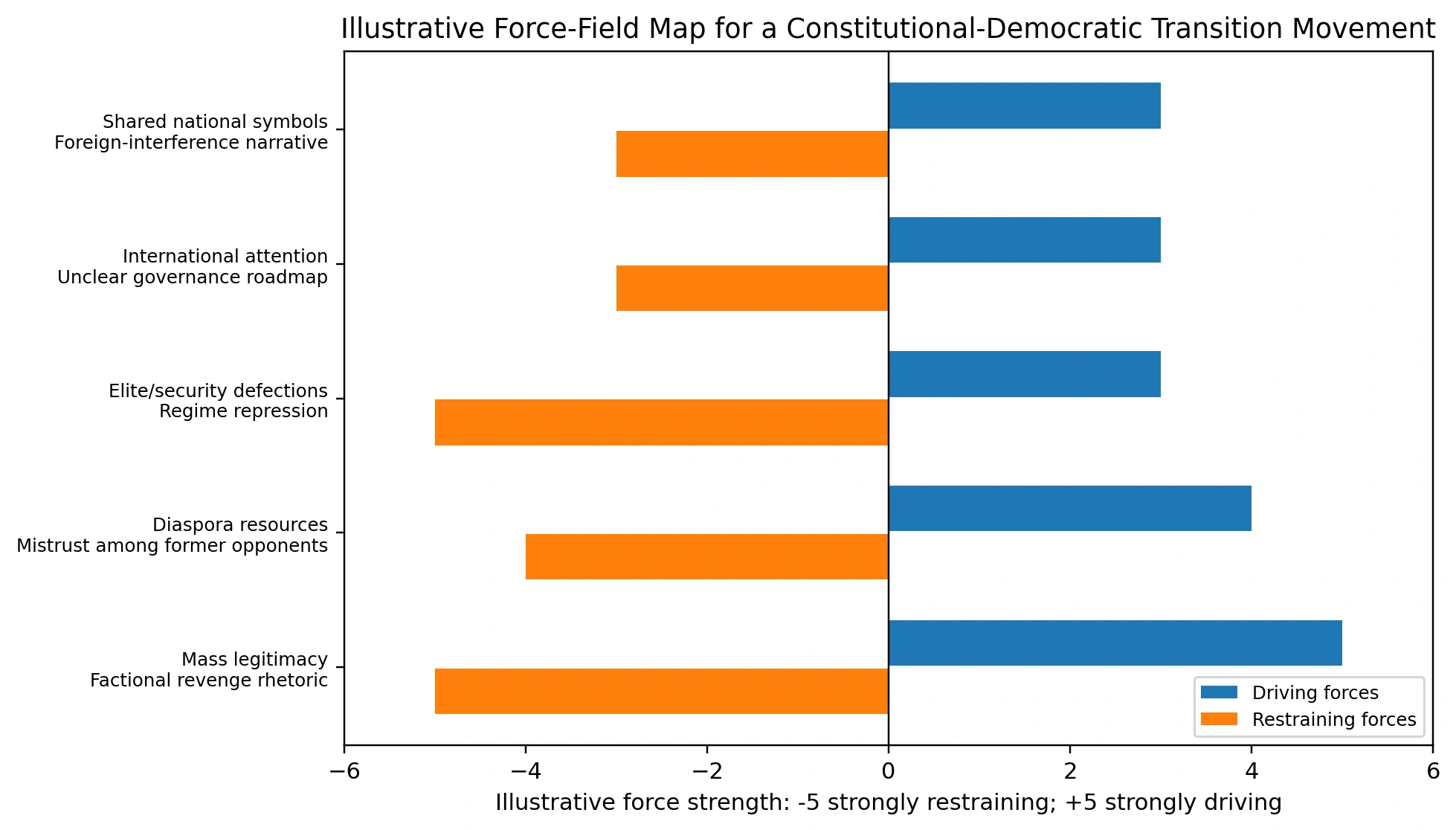
Figure 2. Illustrative force-field analysis; scores are examples, not empirical findings.
3.4 Balanced Scorecard as Performance Governance
Kaplan and Norton introduced the balanced scorecard to combine financial and non-financial indicators, linking strategic goals to performance measures (Kaplan & Norton, 1992). In a civic movement, the equivalent is not profit but legitimacy, organisational capacity, stakeholder trust, policy readiness and risk control.
Perspective | Strategic question | Possible KPIs |
|---|---|---|
Legitimacy | Are we becoming more trusted by Iranians with different histories and ideologies? | Survey signals; diversity of endorsers; sentiment analysis; reduction in factional hostility; transparency of leadership structures. |
Coalition and stakeholders | Are we building bridges rather than purges? | Number of cross-ideological working contacts; conflict-resolution outcomes; defectors protected by due-process language. |
Internal process | Can we make decisions consistently? | Use of written decision memos; risk logs; fact-checking protocols; meeting minutes; action owners. |
Learning and adaptation | Do we learn from mistakes and evidence? | Post-action reviews; updated PESTLE scans; correction of misinformation; scenario exercises. |
Rights and rule of law | Do our methods prefigure the democratic state we claim to seek? | No collective guilt; no incitement; explicit due-process commitments; human-rights compliance screening. |
4. Stakeholder Typology Within the Constitutional-Democratic Pro-Pahlavi Space
The following typology is analytical, not moral. It identifies likely motivations, fears and strategic risks among constituencies that may support Crown Prince Reza Pahlavi or a constitutional-monarchy option for different reasons. The practical value is conflict prevention: a coalition cannot be managed if its internal psychology is ignored.
Group | Main motivation | Typical fear | Strategic risk | Bridge-building principle |
|---|---|---|---|---|
Exile-era symbolic or romantic royalists | Memory of pre-1979 statehood, personal loss, loyalty to monarchy, anger at the revolutionary coalition. | That compromise with former leftists, Islamists or regime-adjacent individuals dishonours the past. | Revenge rhetoric; glorification of authoritarian tools; alienating undecided citizens and defectors. | Affirm historical memory while separating justice from vengeance and rejecting collective punishment. |
Pragmatic monarchists who remained in or near Iran | Exhaustion after reformism, elections, protest cycles or ideological alternatives; desire for continuity and a unifying symbol. | That diaspora hardliners do not understand survival under authoritarian rule. | Distrust between inside and outside activists; accusations of opportunism. | Respect survival complexity; judge present conduct and future commitments through transparent criteria. |
Defectors or former regime-adjacent actors | Recognition that the current system is unsustainable; desire for national continuity and managed transition. | Exposure, humiliation, revenge, or exclusion despite potential usefulness for peaceful transition. | If alienated, they may stay silent or remain with coercive institutions; if accepted without vetting, they may damage credibility. | Use individual vetting, truth-telling, proportional accountability and due process. |
Non-monarchist democratic actors | Shared opposition to the Islamic Republic and support for secular democracy, but preference for republican or other constitutional forms. | That monarchy supporters will predetermine the outcome before a vote. | Coalition breakdown over final-state ideology before transition. | Separate transitional minimum programme from final constitutional competition. |
General public and undecided majority | Security, bread, dignity, rights, services, stability and freedom from chaos. | Civil war, revenge, economic collapse, foreign domination or another dictatorship. | Symbolic debates may appear detached from daily survival. | Translate constitutional principles into security, livelihood, justice and service-delivery guarantees. |
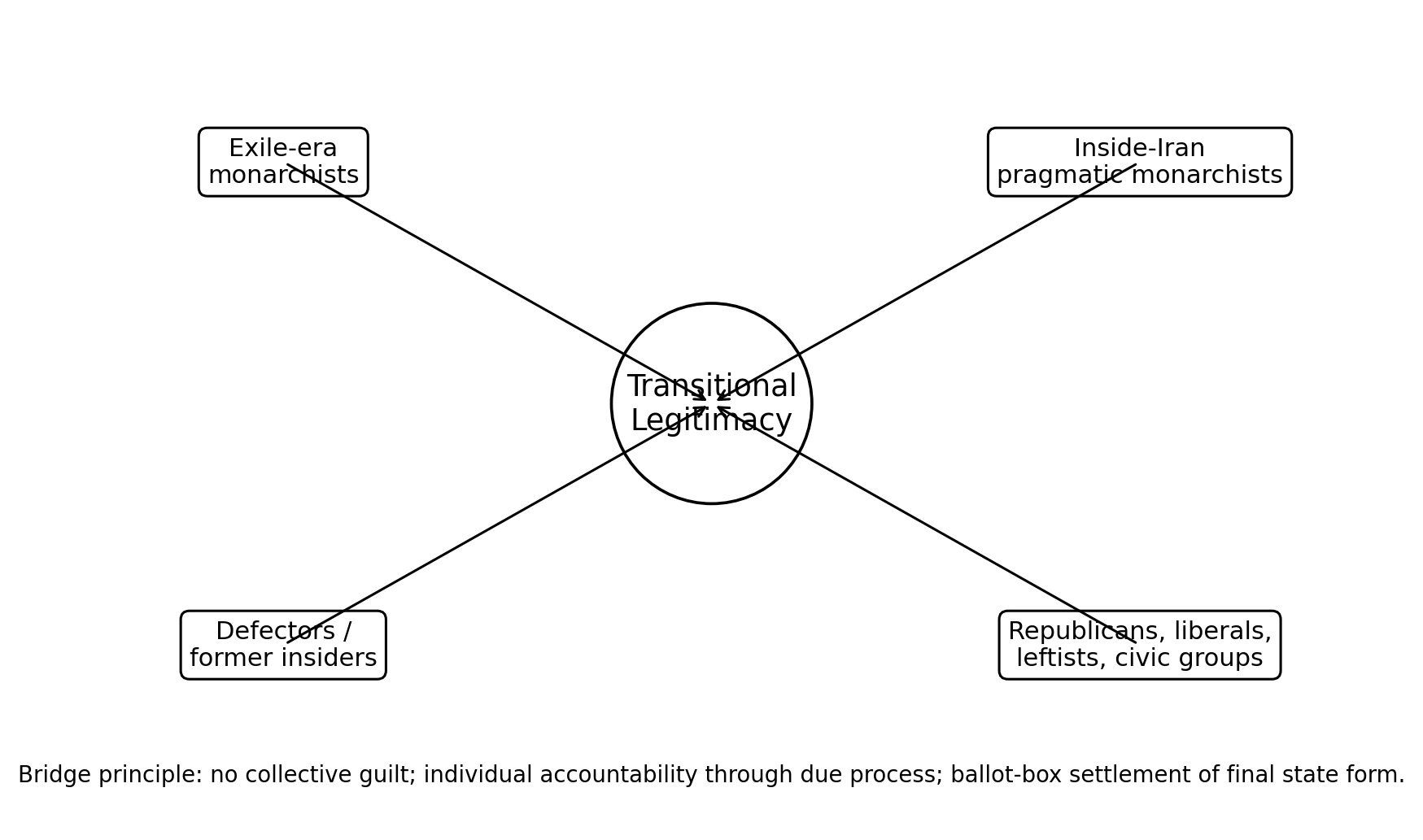
Figure 3. Stakeholder bridge logic for transitional legitimacy.
5. Decision Principle: Measure Every Action Against the Goal
The central operational rule is simple: every speech, alliance, slogan, protest tactic, media appearance, policy document, lobbying action and internal disciplinary decision should be scored against the strategic goal. If an action satisfies emotional appetite but damages unity, legitimacy, defections, rights compliance or public trust, it should be redesigned or abandoned.
The paper proposes the following decision equation. It is not a mathematical law; it is a disciplined governance heuristic:
Strategic Value = Goal Alignment + Legitimacy Gain + Coalition Gain + Capacity Gain + Rights Compliance - Operational Risk - Polarisation Cost - Misinformation Risk - Revenge/Repression Risk
This equation is valuable because it forces activists to ask whether a decision advances the transition or merely expresses identity, anger or factional superiority.
6. Practical Scoring System
A score from 0 to 5 can be assigned to each criterion before a decision is made. Zero means no evidence of benefit or high risk; five means strong evidence of benefit and manageable risk. Negative criteria are reverse-scored. The model should be used comparatively across options, not as false precision.
Criterion | 0 | 3 | 5 | Suggested evidence |
|---|---|---|---|---|
Goal alignment | Unrelated or contradictory | Indirectly supportive | Directly advances stated transition goal | Written rationale linked to SMART goal. |
Unity and coalition effect | Likely to fracture coalition | Mixed or uncertain | Builds trust across groups | Stakeholder consultation, message testing. |
Democratic legitimacy | Predetermines outcome or excludes rivals | Ambiguous | Affirms ballot-box decision and pluralism | Public wording, charter compliance. |
Rule-of-law compliance | Collective blame, revenge rhetoric or incitement | Some risk requiring edits | Due process, proportionality, individual accountability | Legal/human-rights review. |
Operational feasibility | No owner, no resources, vague timeline | Some capacity exists | Clear owner, budget, timeline, fallback plan | Action plan and risk register. |
Information integrity | Unverified claim or propaganda risk | Partly verified | Triangulated and sourced | Fact-check log and source quality. |
Defection/reconciliation value | Threatens potential defectors indiscriminately | Neutral | Encourages lawful exit from coercive institutions | Defector messaging and vetting pathway. |
International credibility | Appears extremist or chaotic | Limited effect | Signals professionalism and democratic discipline | Diplomatic, media and civil-society feedback. |
Illustrative Decision Scorecard
The table below shows how three hypothetical actions might be assessed. Scores are illustrative and should be replaced by actual evidence before real-world use.
Option | Goal | Unity | Legitimacy | Rule law | Feasible | Integrity | Total | Gate |
|---|---|---|---|---|---|---|---|---|
Transition charter | 5 | 5 | 5 | 5 | 4 | 5 | 29/30 | Proceed |
Revenge slogans | 1 | 0 | 0 | 0 | 4 | 2 | 7/30 | Stop/redesign |
Cross-ideological forum | 5 | 4 | 5 | 5 | 3 | 4 | 26/30 | Proceed with safeguards |
Option descriptions: (1) a transition charter affirming secular democracy, territorial integrity, equality before law and a referendum/free election; (2) revenge-oriented slogans against broad categories of former leftists, Islamists or former insiders; and (3) a cross-ideological policy forum with clear rules: no violence, no collective guilt and final state form decided by public vote.
7. PESTLE Analysis Applied to the Iranian Transition Context
The following analysis is based on open-source information and general transition literature. It is not a covert assessment of Iranian domestic organisation.
7.1 Political Factors
The main political problem is fragmentation. Reuters described opposition to the clerical government as fragmented and noted uncertainty about how much support Pahlavi has in Iran, while also reporting his proposed gathering across the ideological spectrum to agree on transition principles (Reuters, 2025). Fragmentation means that symbolic leadership may be useful as a coordination device, but it is insufficient without institutional design, dispute-resolution mechanisms and a credible guarantee that final political competition remains open.
7.2 Economic Factors
Economic distress can create both mobilisation potential and chaos risk. The World Bank continues to track Iran through Iran Economic Monitor updates and macroeconomic data, while public reporting highlights the impact of sanctions, conflict and energy pressures. A transition movement should therefore communicate economic continuity, protection of essential services, anti-corruption, stabilisation and reconstruction capacity rather than only constitutional symbolism.
7.3 Social Factors
Social memory is divided. Some remember the Pahlavi era as modernisation and state-building; others remember repression, exclusion or SAVAK. Some remember 1979 as a catastrophe; others may have complex family histories involving revolution, war, state service, reformism or survival. A democratic movement should not demand that all groups share identical memory. It should require a shared future rule: no collective guilt, no revenge, individual accountability by law, and final constitutional decision by citizens.
7.4 Technological Factors
Digital media can scale messages rapidly but also amplifies misinformation, personality cults, foreign manipulation, surveillance risks and factional attacks. Therefore, a movement should maintain verification protocols, secure communications, source-quality scoring and correction mechanisms.
7.5 Legal Factors
The legal challenge is to distinguish justice from revenge. Transitional justice may include truth-seeking, vetting, criminal accountability for serious crimes, reparations and institutional reform. However, collective punishment against ideological categories would contradict equality before law and would damage both domestic and international legitimacy.
7.6 Environmental Factors
Environmental pressures such as water scarcity, pollution and infrastructure degradation should not be treated as secondary. Post-transition legitimacy can collapse if citizens experience insecurity, water shortages, unemployment, electricity disruption or administrative paralysis. A transition programme should therefore connect constitutional legitimacy to practical governance capability.
8. Lessons from Democratic Transition Literature
Comparative transition literature stresses coalition breadth, institutional uncertainty and the dangers of polarisation. Dahlum (2023) finds that socially diverse protest movements are more likely to overthrow authoritarian regimes, but also warns that diverse movements may be vulnerable to fragmentation and infighting after authoritarian breakdown. This is directly relevant to Iranian opposition politics: diversity is a strength only if it is governed by rules.
Mansfield and Snyder (2002) warn that democratization without strong institutions can coincide with nationalist conflict and instability. The implication is not that transition should be avoided; rather, transition movements should prioritise institutions, security-sector reform, information discipline and inclusive rules before rupture occurs.
Opposition-coalition research also suggests that coalitions can increase pressure on authoritarian systems, but coalition building requires credible mechanisms for power-sharing, candidate selection, dispute resolution and trust. In the Iranian case, a transitional minimum programme should be separated from final constitutional competition. The minimum programme can include secular government, territorial integrity, free media, independent judiciary, human rights and a referendum; monarchy versus republic can then be decided by citizens.
9. Transitional Justice: The Line Between Accountability and Revenge
A central risk in the author-described movement is revenge psychology among some hardline royalists or anti-1979 constituencies. This is understandable as trauma, but dangerous as governance. If a future constitutional order begins with collective punishment, it undermines equality before law before the new state is even born.
A rights-compliant accountability model should separate four categories:
Category | Treatment under rule of law | Strategic rationale |
|---|---|---|
Serious crimes: torture, murder, mass repression, corruption involving major public harm | Investigation, evidence, fair trial, independent judiciary. | Demonstrates justice without revenge. |
Administrative or low-level service under the Islamic Republic without evidence of serious abuse | Vetting, disclosure, possible temporary restrictions in sensitive roles. | Avoids collapsing the state by purging all expertise. |
Defectors who provide evidence and accept democratic rules | Protected channels, truth-telling obligations, conditional reintegration. | Encourages peaceful transition and splits coercive structures. |
Political opponents who support secular democracy but reject monarchy | Full political participation under equal rules. | Prevents the movement from becoming authoritarian before elections. |
This approach is morally and strategically superior to collective revenge because it increases defections, reassures the undecided public, preserves administrative capacity and aligns the movement with its own rule-of-law claim.
10. Decision Matrix: Legitimacy-Risk Gate
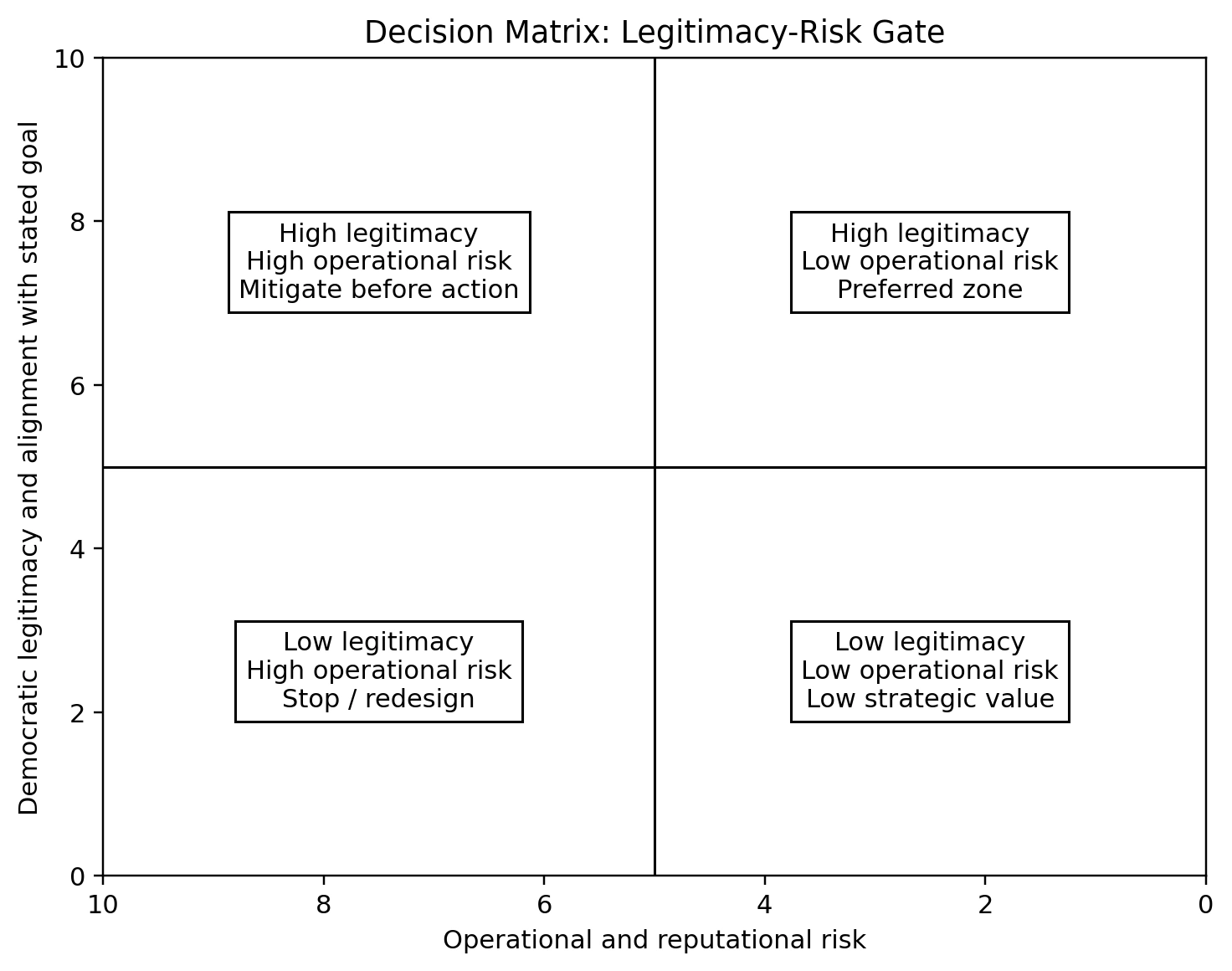
Figure 4. Legitimacy-risk gate for accepting, redesigning or rejecting proposed actions.
The legitimacy-risk gate is a simple control mechanism. Any action with low democratic legitimacy and high risk should be stopped, even if it is emotionally satisfying. Any action with high legitimacy but high risk should be mitigated before implementation. Actions with high legitimacy and low risk should be prioritised. Actions with low legitimacy and low risk may still be strategically irrelevant and should not consume scarce attention.
11. Proposed Governance Protocol for Activist Decision-Making
The following protocol converts the paper into a working method. It can be used by a civic committee, diaspora organisation, policy working group or campaign team.
Step | Question | Output |
|---|---|---|
1. Define SMART goal | What exact goal does this action serve? | One-sentence goal and deadline. |
2. Conduct PESTLE scan | Which external factors matter? | Short risk and opportunity memo. |
3. Map stakeholders | Who is affected, reassured, alienated or mobilised? | Stakeholder map and consultation plan. |
4. Design options | What are at least three possible actions? | Option list, including do-nothing option. |
5. Score options | Which option improves legitimacy, unity, capacity and rights compliance most? | Decision scorecard. |
6. Apply red-line screen | Does it include incitement, collective guilt, misinformation or anti-pluralism? | Proceed, redesign or stop decision. |
7. Assign ownership | Who acts, by when, with what resources and safeguards? | RACI-style action owner table. |
8. Review outcomes | What happened compared with expected results? | After-action review and learning update. |
12. Red-Line Principles
No collective guilt: leftists, Islamists, reformists, former insiders, ethnic groups, religious groups or republicans cannot be treated as guilty by category.
No glorification of repression: a democratic movement cannot legitimise arbitrary violence or secret-police methods as a future governance model.
No predetermined constitution: constitutional monarchy may be advocated, but the final form must be decided through free public choice.
No misinformation: claims about casualties, defections, public opinion, foreign support or opposition unity require source-quality grading.
No personal cult replacing institutions: symbolic leadership can coordinate, but institutions must govern.
No revenge as policy: accountability must occur through evidence, individual responsibility and due process.
13. Model Charter Clause
A transition-oriented civic movement could adopt a clause such as the following:
“We support a peaceful or least-violent possible transition from the Islamic Republic to a secular, democratic and pluralist constitutional order that preserves Iran’s territorial integrity, guarantees equality before law, protects individual freedoms and submits the final form of state, including monarchy or republic, to the free decision of the Iranian people through transparent electoral mechanisms. We reject collective punishment, revenge politics, ideological exclusion and glorification of unlawful repression. Accountability shall be individual, evidence-based and governed by due process.”
14. Discussion
The management implication is that unity cannot be demanded; it must be engineered. A coalition containing exile-era monarchists, inside-Iran pragmatists, defectors and non-monarchist democrats requires a minimum common programme and a conflict-management system. Without that, symbolic energy can become destructive competition.
The paper also suggests that the most dangerous failure mode is not ideological disagreement. Disagreement is normal in democratic politics. The dangerous failure mode is anti-democratic method inside a pro-democratic movement: purging dissent, humiliating potential allies, inventing purity tests, circulating unverified claims, or substituting personal loyalty for rule-based decision-making.
A constitutional-monarchy option can be presented as a continuity-and-unity model only if its supporters visibly accept pluralism, due process, ballot-box legitimacy and institutional restraint. If some supporters instead communicate nostalgia for unrestricted coercive power, they weaken the very legitimacy they seek to build.
15. Limitations
This paper uses open-source material and management theory; it does not include confidential polling, field interviews inside Iran or classified security data.
The scoring system is a governance heuristic, not a predictive statistical model.
The stakeholder categories are analytical ideal-types; real individuals may belong to more than one category or change over time.
Because political conditions change rapidly, PESTLE assumptions require regular revision.
The paper does not endorse violence, foreign military intervention or extra-legal punishment.
16. Conclusion
The strategic challenge for a constitutional-democratic Iranian transition movement is to transform emotional energy into disciplined legitimacy. SMART goals clarify the destination; PESTLE identifies external constraints; force-field analysis reveals drivers and restraining forces; stakeholder mapping prevents coalition blindness; balanced scorecards measure whether actions actually advance the goal. The central rule is that every decision should be tested against measurable contribution to democratic legitimacy, unity, non-violence, pluralism, rule of law, administrative capacity and ballot-box confirmation.
The paper’s practical conclusion is that a movement seeking to replace an authoritarian system must not imitate authoritarian decision habits. It should prefigure the future state it claims to want: lawful, pluralist, accountable, evidence-based and respectful of citizens’ final sovereign decision.
Appendix A. One-Page Decision Memo Template
Field | Content to complete before decision |
|---|---|
Decision title | Short name of proposed action. |
SMART goal served | Specific, measurable, achievable, relevant and time-bound goal. |
PESTLE summary | Political, economic, social, technological, legal and environmental factors. |
Stakeholders affected | Supporters, opponents, undecided public, inside-Iran actors, diaspora, international observers. |
Options compared | At least three options, including no action. |
Scorecard result | Numerical and narrative score. |
Rights/rule-of-law screen | Due process, no incitement, no collective guilt, source verification. |
Risk controls | Mitigation, communication plan, security plan. |
Owner and timeline | Responsible person/team and review date. |
After-action review | What was learned and what should change. |
Appendix B. RACI Template for Movement Decisions
Task | Responsible | Accountable | Consulted | Informed |
|---|---|---|---|---|
Draft transition statement | ||||
Fact-check claims | ||||
Legal/human-rights review | ||||
Stakeholder consultation | ||||
Media release | ||||
After-action review |
References
Amnesty International. (2026). Human rights in Iran. Retrieved 22 May 2026 from https://www.amnesty.org/en/location/middle-east-and-north-africa/middle-east/iran/
Bjerke, M. B., & Renger, R. (2017). Being smart about writing SMART objectives. Evaluation and Program Planning, 61, 125-127.
Cambridge Institute for Manufacturing. (n.d.). Force field analysis. Retrieved 22 May 2026 from https://www.ifm.eng.cam.ac.uk/research/dstools/force-field-analysis/
CIPD. (2026). PESTLE analysis factsheet. Retrieved 22 May 2026 from https://www.cipd.org/en/knowledge/factsheets/pestle-analysis-factsheet/
Council on Foreign Relations. (2025). A conversation with Reza Pahlavi. Retrieved 22 May 2026 from https://www.cfr.org/event/conversation-reza-pahlavi
Dahlum, S. (2023). Joining forces: Social coalitions and democratic revolutions. Journal of Peace Research, 60(3), 439-453.
Doran, G. T. (1981). There’s a S.M.A.R.T. way to write management’s goals and objectives. Management Review, 70(11), 35-36.
Freedom House. (2026). Iran: Freedom in the World 2026 country report. Retrieved 22 May 2026 from https://freedomhouse.org/country/iran/freedom-world/2026
Kaplan, R. S., & Norton, D. P. (1992). The balanced scorecard: Measures that drive performance. Harvard Business Review, 70(1), 71-79.
Mansfield, E. D., & Snyder, J. (2002). Democratic transitions, institutional strength, and war. International Organization, 56(2), 297-337.
Reuters. (2025, June 23). “Regime change” is only solution in Iran, Shah’s son says. Retrieved 22 May 2026 from https://www.reuters.com/business/media-telecom/regime-change-is-only-solution-iran-shahs-son-says-2025-06-23/
The Guardian. (2026, February 15). Rallies held across the world in support of Iran’s anti-government protesters. Retrieved 22 May 2026 from https://www.theguardian.com/world/2026/feb/15/rallies-held-across-the-world-in-support-of-irans-anti-government-protesters
World Bank. (2026). Islamic Republic of Iran country page and Iran Economic Monitor resources. Retrieved 22 May 2026 from https://www.worldbank.org/ext/en/country/iran