
Political essay
In-depth Risk, Success-Failure Analysis of the Lion and Sun Movement in Iran
This report is not an endorsement of any political actor, party, ideology, foreign policy option, military action, or constitutional form.
English article
A neutral, evidence-weighted analytical report with structured risk register, scenario assessment, tables and graphs
Date: 21 May 2026
Analytical note
This report is not an endorsement of any political actor, party, ideology, foreign policy option, military action, or constitutional form. It evaluates structural factors that may enable or inhibit a political movement and a possible transition. Where open-source evidence is disputed, unverifiable, or based on claims from interested actors, the report labels it as such. The report deliberately avoids operational advice for confrontation, sabotage, armed activity, or security-force targeting.
Executive summary
Iran is facing an unusually concentrated set of pressures: economic contraction, inflation, sanctions, conflict disruption, a legitimacy crisis following lethal protest repression, nuclear-related diplomatic pressure, and regional isolation linked to proxy networks and maritime escalation. These pressures create conditions favourable to demands for change, but they do not automatically translate into a successful democratic transition.
The Lion and Sun movement has several mobilising assets: a recognisable national symbol, a simple anti-theocratic message, a pro-Western and secular-democratic framing among many supporters, and an identifiable figure in Reza Pahlavi. Its principal vulnerabilities are equally substantial: contested legitimacy inside Iran, monarchist-restoration fears, association with past repression and SAVAK symbolism among some supporters, diaspora/internal disconnects, ethnic and ideological fragmentation, and the risk that external military conflict could either accelerate regime fracture or strengthen regime narratives of foreign aggression.
The evidence supports a cautious conclusion: the movement can become a major component of a broader national transition coalition if it is perceived as pluralistic, non-vengeful, constitutionally limited, and subordinate to an inclusive democratic process. It is less likely to succeed if it is perceived as a narrow royalist project, externally installed, intolerant of leftists/republicans/ethnic minorities, or dependent on foreign military intervention.
Methodology and scoring framework
The report uses a qualitative risk-management framework adapted from ISO 31000-style risk registers and scenario analysis. Instead of claiming mathematical certainty, factors are classified by direction, impact, likelihood, time horizon and confidence. “Supports change” means the factor increases pressure on the Islamic Republic or improves mobilisation capacity. “Inhibits success” means the factor weakens the movement’s ability to convert unrest into a durable, legitimate transition. “Ambivalent” means the same factor can help or harm depending on sequence and perception.
Dimension | Low | Medium | High | Very high |
|---|---|---|---|---|
Impact | Symbolic or local effect | Material effect on narrative or turnout | National effect on mobilisation, repression, or legitimacy | Could determine whether transition succeeds, fails, or becomes violent |
Likelihood | Unlikely or weakly evidenced | Plausible but uncertain | Likely or strongly evidenced | Already occurring or structurally embedded |
Confidence | Anecdotal / partisan evidence | Mixed open-source evidence | Credible public evidence | Multiple credible sources / official data |
Important limitation: this framework is diagnostic, not predictive. It should not be read as a forecast of inevitable uprising, collapse, restoration, civil war, or democratic consolidation.
Evidence base: core facts and uncertainties
Protest repression. UK country information reporting states that Iranian authorities responded forcefully to the December 2025-January 2026 protests and that verified video showed the use of lethal force, including batons and firearms. It also notes that the crackdown suppressed protest activity by mid-January. Claims of “thousands” killed on 8-9 January appear in some human rights and media reporting, but casualty figures remain difficult to verify because of communications restrictions and competing estimates. This report therefore treats the scale as severe and politically transformative while avoiding a single definitive death toll. [6]
Economic stress. The World Bank’s April 2026 Macro Poverty Outlook estimates that Iran’s GDP contracted by 2.7 percent in 2025/26, cites conflict, protests, intensified hostilities, trade disruption, and a 44 percent year-on-year currency depreciation in early March 2026, and reports consumer price inflation at 49.1 percent in 2025/26. [2]
Nuclear and sanctions pressure. The E3 statement to the IAEA Board of Governors said Iran remained the only non-nuclear-weapon state to have produced 60 percent highly enriched uranium and expressed concern that the IAEA could not account for Iran’s uranium stockpile. [3]
Regional proxy model. Belfer Center analysis describes Iran’s decades-long “axis of resistance” strategy across Lebanon, Syria, Iraq, Yemen and Gaza and argues that this model has entered structural degradation. [4]
Strait of Hormuz and war effects. Reuters reported in May 2026 that Iran had consolidated de facto control over parts of the Strait of Hormuz through island checkpoints, vetting mechanisms, government-to-government arrangements and possible fees, with the IRGC playing a central role. Reuters also reported that fewer than 60 ships crossed between 18 April and 6 May, compared with 120-140 on a typical pre-war day. [5]
Opposition legitimacy and fragmentation. Sources from Manara, AP, ABC and The Guardian identify legitimacy, foreign-proxy accusations, contested historical memory, Kurdish/ethnic tensions, and opposition disunity as central vulnerabilities for Reza Pahlavi and the broader Lion and Sun/Pahlavi-aligned ecosystem. [7-10]
Decentralised repression / “Talibanised” security posture. The specific claim that the regime has purchased large numbers of Hilux/Toyota vehicles and dispersed forces across the country could not be confirmed from reliable public sources in this review. The broader strategic concept - decentralised, mobile repression after attacks on fixed assets - is plausible, but the vehicle-number claim should be treated as unverified.
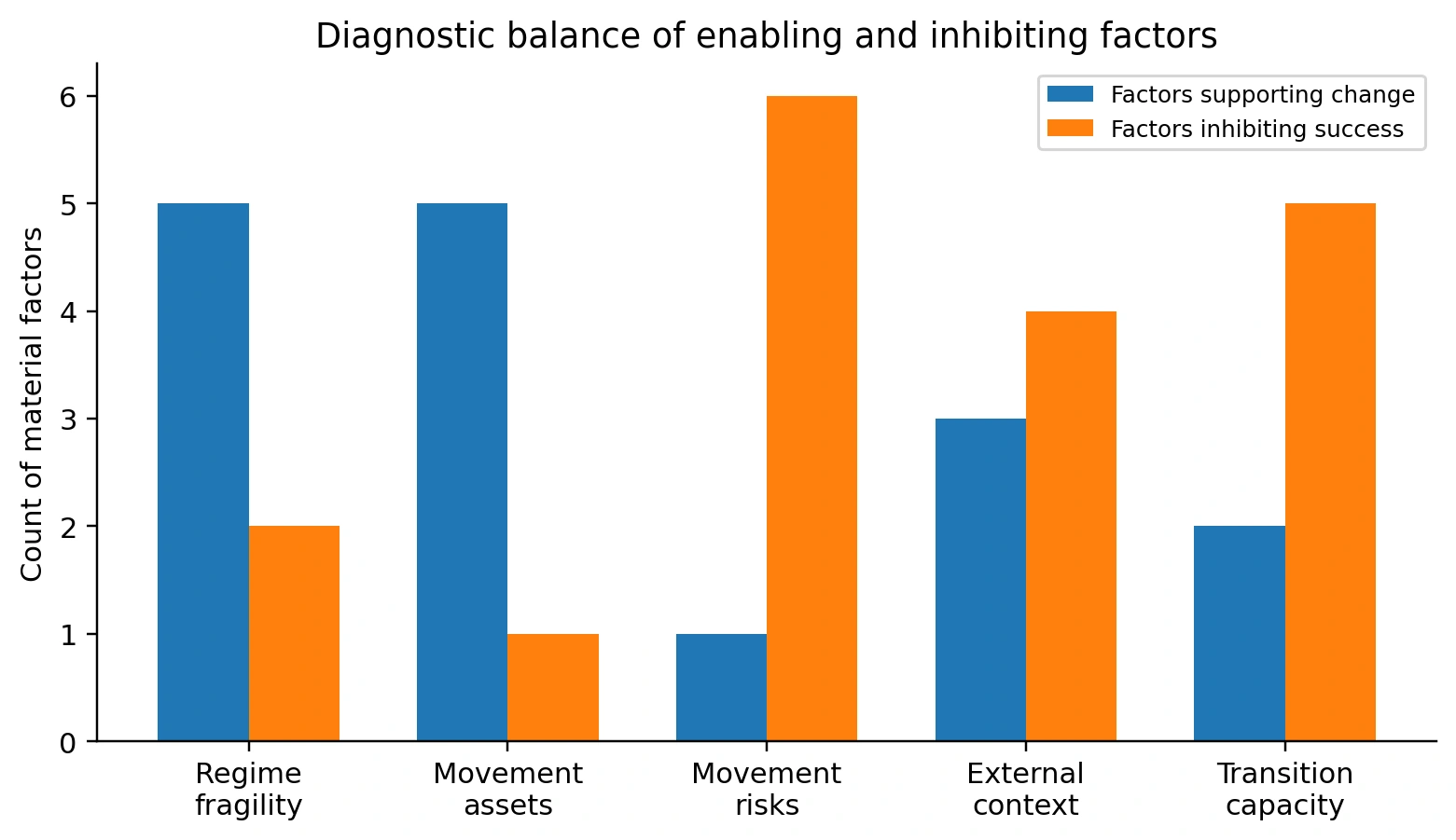
Figure 1. Diagnostic balance of enabling and inhibiting factors. Counts are qualitative analytical categories, not a prediction of outcome.
Strategic factor matrix
Factor | Direction | Impact | Evidence/confidence | Interpretation |
|---|---|---|---|---|
Economic contraction, inflation and currency depreciation | Supports change | High | High - World Bank | Raises grievance intensity; also reduces the state’s distributive capacity. But hardship may reduce organisational capacity if people prioritise survival. |
Mass repression and blood grievance after January events | Ambivalent | Very high | Medium/High | Creates a moral rupture between society and state. It can mobilise nonviolent resistance, but fear and trauma can also demobilise. |
Ideological exhaustion of political Islam among many citizens | Supports change | High | Medium | Secular-democratic language can unite groups tired of theocracy, corruption and isolation. Strength depends on breadth across class, ethnicity and geography. |
Leader and symbol: Reza Pahlavi and Lion and Sun flag | Supports change / inhibits pluralism | High | Medium/High | A visible leader and historic flag reduce coordination costs. However, they also trigger monarchist-restoration fears and alienate some republicans, leftists, ethnic minorities and victims of pre-1979 repression. |
Diaspora media capacity and international visibility | Supports change / risk of disconnect | Medium/High | Medium | Amplifies messaging and lobbying. But a diaspora-dominated narrative can be portrayed as foreign-backed or disconnected from inside-Iran priorities. |
SAVAK nostalgia, vengeance language and anti-left rhetoric among some supporters | Inhibits success | High | Medium | Undermines democratic credibility and strengthens regime propaganda that the alternative is authoritarian restoration. |
Opposition fragmentation: monarchists, republicans, leftists, ethnic groups, civil society | Inhibits success | Very high | High - AP/Guardian/ABC | Fragmentation is one of the biggest barriers to converting protest into transition. It also complicates post-collapse governance. |
Security-force cohesion or defection | Ambivalent | Very high | Low/Medium | Successful transitions often require loyalty shifts. Claims of large organised defection remain contested or unverifiable. |
External war / renewed US-Israel strikes | Ambivalent | Very high | Medium/High | Could weaken regime capacity and raise elite panic, but could also produce civilian harm, nationalist rally effects, or the perception of foreign installation. |
Western preference for negotiation over revolution | Inhibits rapid success | Medium/High | High | UK/EU/US priorities may focus on nuclear containment, energy security and Hormuz rather than regime change, reducing external political oxygen for revolutionary narratives. |
Iran’s regional isolation after proxy and Hormuz escalation | Supports change | Medium/High | High | Regional isolation can weaken regime resources and legitimacy. It may also produce siege narratives. |
Absence of an accepted transitional charter, inclusion mechanism and constitutional timetable | Inhibits success | Very high | Medium/High | Without a credible transition architecture, regime collapse could produce fragmentation, military rule, or renewed authoritarianism. |
Risk register
Risk | Likelihood | Impact | Risk level |
|---|---|---|---|
Regime uses mass repression and communications shutdowns | High | High | Very high |
Movement is portrayed as foreign-backed or monarchist restoration | High | High | Very high |
Opposition fragmentation across monarchist, republican, ethnic and left-right lines | High | High | Very high |
External war delegitimises civil mobilisation or causes rally-around-the-flag effects | Medium/High | High | High |
Economic collapse drives protest but weakens society’s capacity to organise | High | Medium/High | High |
Security-force defection remains unverified or episodic | Medium | High | High |
International actors prioritise nuclear/hormuz negotiations over democratic transition | High | Medium | High |
Post-collapse governance gap: no accepted transitional charter or security plan | Medium | Very high | High |
Success conditions and failure pathways
Success condition 1 - pluralistic constitutional credibility. The movement’s most important conversion problem is the gap between protest symbolism and trust in future institutions. A movement that presents the Lion and Sun as a national rather than exclusively monarchist symbol, and Reza Pahlavi as a limited transitional facilitator rather than a predetermined ruler, would reduce fear among republicans, leftists, ethnic minorities and sceptical international actors. This is an analytical observation, not a recommendation or endorsement.
Success condition 2 - nonviolent discipline and broad participation. Civil-resistance literature finds that nonviolent campaigns can turn repression into political backfire more effectively than violent campaigns and are more likely to generate loyalty shifts in security forces. This does not mean repression automatically helps protesters; fear, trauma and internet shutdowns can equally suppress mobilisation. [11]
Success condition 3 - internal legitimacy over external installation. Several sources warn that legitimacy cannot be imported and that foreign sponsorship or visible dependence on US/Israeli military action can undermine domestic legitimacy. The movement’s strategic vulnerability is not merely whether foreign states support it, but whether Iranians inside the country perceive it as their own instrument of self-determination. [7,10]
Success condition 4 - a credible transition architecture. Historical transitions are more stable when there is an accepted constitutional timetable, inclusion of soft-liners or institutional defectors where feasible, civilian control of security institutions, protection of minorities, and a mechanism for accountability that avoids indiscriminate vengeance. The risk is not only regime survival; it is also regime collapse without democratic consolidation.
Failure pathway 1 - royalist narrowing. If the movement becomes defined by restorationist symbolism, SAVAK nostalgia, hostility to leftists/republicans, or intolerance toward ethnic-minority claims, it may lose the breadth required for a national transition coalition.
Failure pathway 2 - war-led delegitimation. If renewed war is associated with civilian casualties, infrastructure collapse or foreign plans to install an exile leadership, the regime may regain narrative power despite its internal unpopularity.
Failure pathway 3 - authoritarian hardening. A decentralised security posture, communications shutdowns, mobile repression, arrests and executions can suppress mobilisation even in a deeply unpopular regime, especially if elite and IRGC cohesion remains intact.
Failure pathway 4 - post-collapse vacuum. A sudden breakdown without an agreed national compact could produce competing armed authorities, ethnic tensions, revenge violence, or military-security rule under a new label.
Scenario analysis
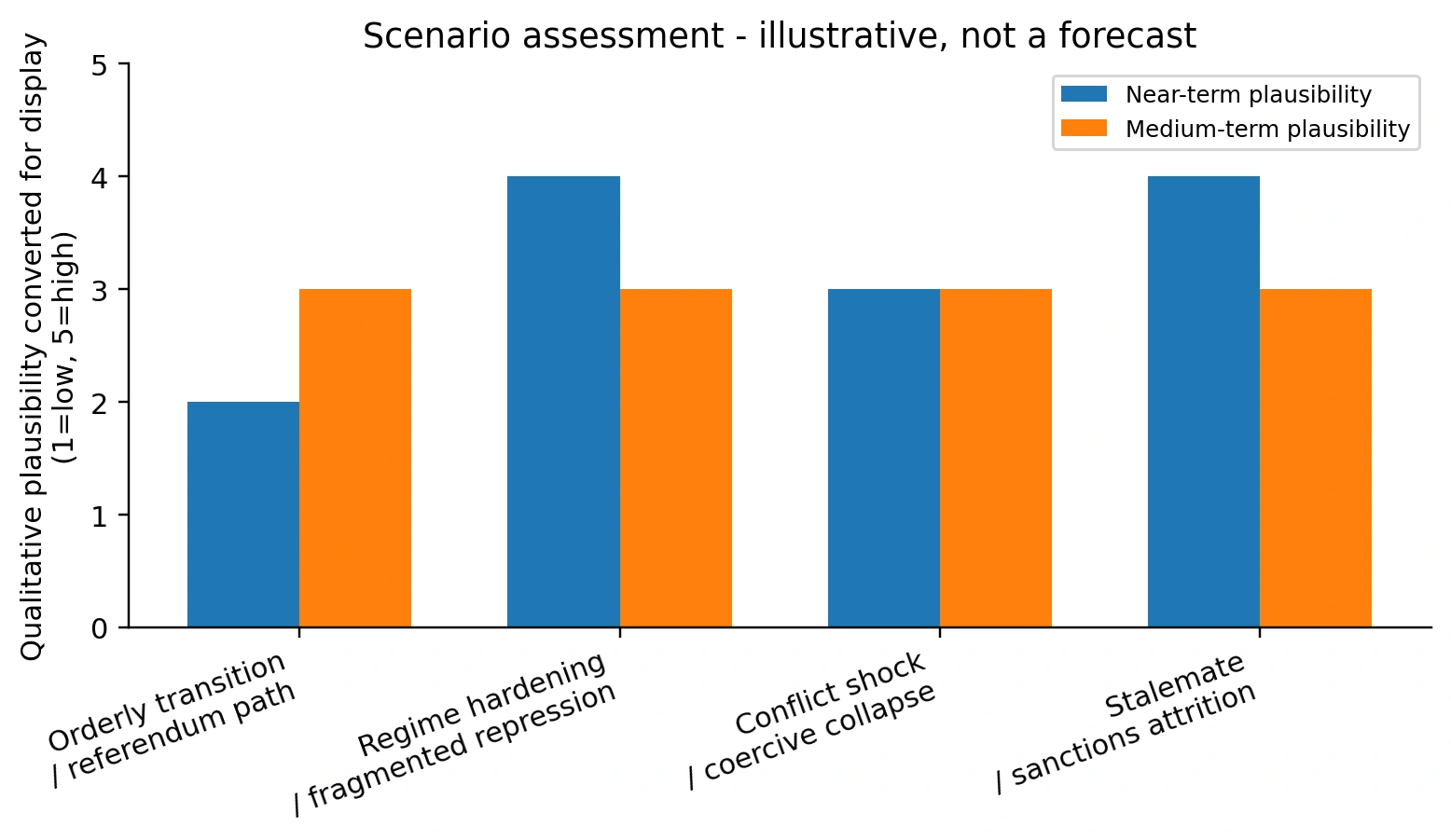
Figure 2. Scenario assessment. Numerical display is used only to visualise qualitative categories; it is not a forecast or ranking of preferred outcomes.
Scenario | Analytical reading |
|---|---|
Orderly transition / referendum path | Requires regime fracture or elite softening, broad opposition pact, nonviolent mobilisation, and credible transition body. Currently possible but institutionally underdeveloped. |
Regime hardening / fragmented repression | Consistent with recent crackdown patterns, communications restrictions, and possible decentralised security posture. This is a strong near-term risk if security institutions remain cohesive. |
Conflict shock / coercive collapse | Renewed war could degrade state capacity and accelerate elite panic, but could also produce nationalist backlash, humanitarian crisis, and accusations of foreign installation. |
Stalemate / sanctions attrition | The regime survives but legitimacy and economic capacity continue to deteriorate. Protest waves recur, but without decisive organisational conversion. |
Conclusion
The Lion and Sun movement benefits from a severe crisis of legitimacy inside the Islamic Republic, economic stress, ideological exhaustion of theocracy, a powerful national symbol, and a recognisable figure. These are real mobilisation assets. However, the pathway from anti-regime sentiment to democratic transition is blocked by repression, fragmented opposition, contested historical memory, unclear organisational depth inside Iran, the unresolved constitutional question, ethnic and ideological mistrust, and the danger that renewed war or foreign sponsorship could delegitimise the movement.
The most defensible conclusion is conditional rather than deterministic: the movement’s chance of becoming a successful vehicle for democratic transition increases if it is embedded in a broad, inclusive, nonviolent, constitutional coalition and decreases if it is perceived as a narrow restorationist or foreign-backed project. A new war could weaken the Islamic Republic militarily, but it could also make democratic transition harder by producing humanitarian disruption, nationalist defensive reflexes, and a security vacuum.
References
[1] UK House of Commons Library. Iran: What challenges face the country in 2026?. 9 Jan 2026. https://commonslibrary.parliament.uk/research-briefings/cbp-10456/
[2] World Bank. Iran, Islamic Republic - Macro Poverty Outlook, April 2026. Apr 2026. https://thedocs.worldbank.org/en/doc/65cf93926fdb3ea23b72f277fc249a72-0500042021/related/mpo-irn.pdf
[3] GOV.UK / E3 statement. Implementation of the NPT Safeguards Agreement and UNSC resolutions in Iran. 4 Mar 2026. https://www.gov.uk/government/speeches/implementation-of-the-npt-safeguards-agreement-and-unsc-resolutions-in-iran-e3-statement-to-the-iaea-board-of-governors-march-2026
[4] Belfer Center. The Degradation of Iran’s Proxy Model. 6 Apr 2026. https://www.belfercenter.org/research-analysis/degradation-irans-proxy-model
[5] Reuters. Iran is consolidating control of Hormuz with island checkpoints, diplomatic deals – and sometimes fees. 20 May 2026. https://www.reuters.com/investigations/iran-is-consolidating-control-hormuz-with-island-checkpoints-diplomatic-deals-2026-05-20/
[6] GOV.UK Country Policy and Information Note. Iran: protests of December 2025 to January 2026. Apr 2026. https://www.gov.uk/government/publications/iran-country-policy-and-information-notes/country-bulletin-iran-protests-of-december-2025-to-january-2026-accessible
[7] Manara Magazine. Iran After the Islamic Republic and the Pahlavi Question. 15 Jan 2026. https://manaramagazine.org/2026/01/iran-after-the-islamic-republic/
[8] ABC News Australia. What Iran’s two different flags say about its divided opposition. 24 Jun 2025. https://www.abc.net.au/news/2025-06-25/why-are-there-two-different-iranian-flags-at-protests/105453584
[9] Associated Press. Tensions between son of Iran’s last shah and Kurdish dissidents show cracks in Iranian opposition. Mar 2026. https://apnews.com/article/iran-iraq-kurds-pahlavi-6beae57e9fdc3546a61ec8f1432eef4b
[10] The Guardian. The Iranian state silenced protests with brutality. What now for Iran’s opposition?. 17 Jan 2026. https://www.theguardian.com/world/2026/jan/17/iran-protests-opposition
[11] Chenoweth and Stephan. Why Civil Resistance Works: The Strategic Logic of Nonviolent Conflict. International Security, 2008. https://www.belfercenter.org/sites/default/files/pantheon_files/files/publication/IS3301_pp007-044_Stephan_Chenoweth.pdf
[12] Levitsky and Way. Beyond Patronage: Violent Struggle, Ruling Party Cohesion, and Authoritarian Durability. Perspectives on Politics, 2012. https://www.cambridge.org/core/journals/perspectives-on-politics/article/abs/beyond-patronage-violent-struggle-ruling-party-cohesion-and-authoritarian-durability/2A29AD2633C9A2D699F8A7A13C405DBE