
Political essay
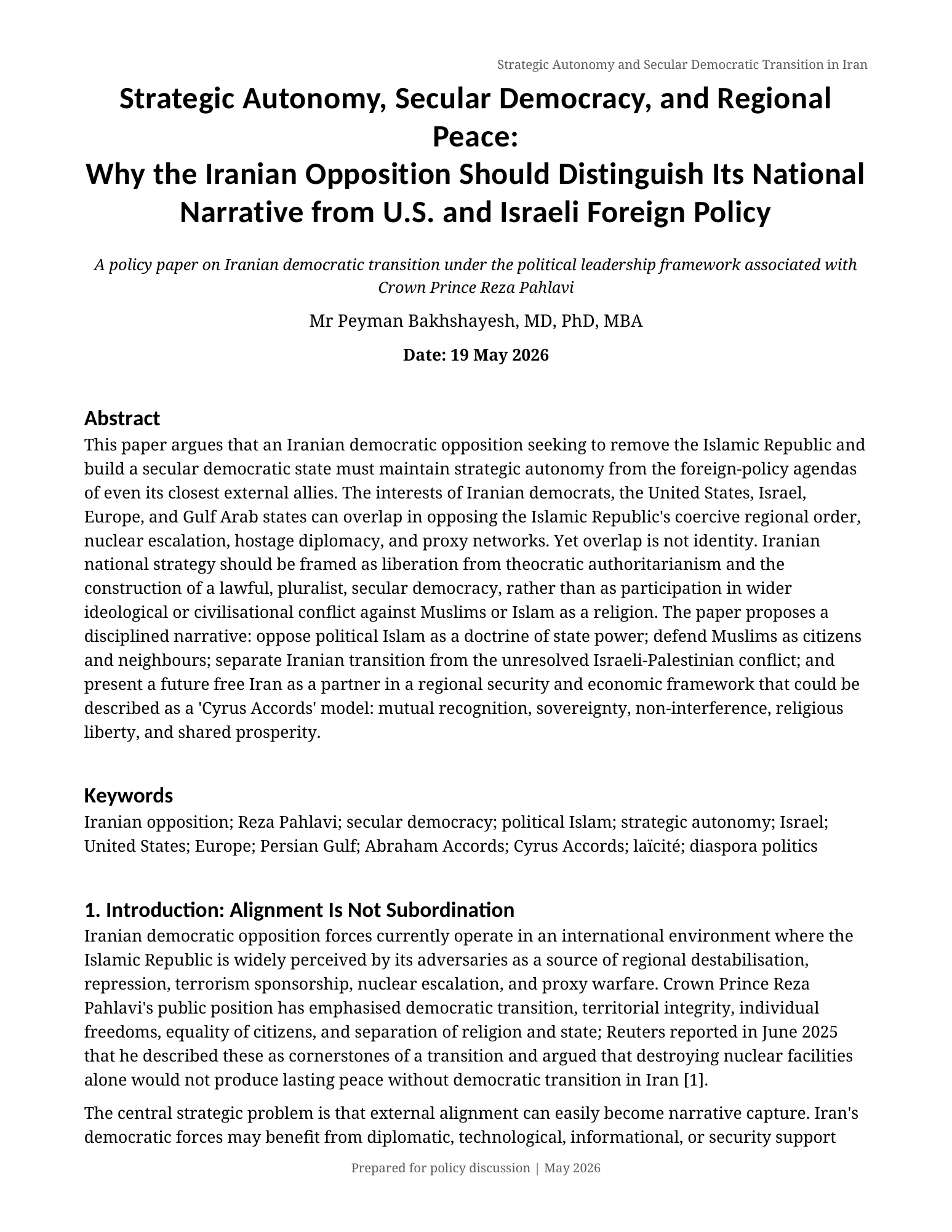
Strategic Autonomy, Secular Democracy, and Regional Peace: Why the Iranian Opposition Should Distinguish Its National Narrative from U.S. and Israeli Foreign Policy
A policy paper on Iranian democratic transition under the political leadership framework associated with Crown Prince Reza Pahlavi
Mr Peyman Bakhshayesh, MD, PhD, MBA
Policy paper dated 19 May 2026
Abstract
This paper argues that an Iranian democratic opposition seeking to remove the Islamic Republic and build a secular democratic state must maintain strategic autonomy from the foreign-policy agendas of even its closest external allies. The interests of Iranian democrats, the United States, Israel, Europe, and Gulf Arab states can overlap in opposing the Islamic Republic's coercive regional order, nuclear escalation, hostage diplomacy, and proxy networks. Yet overlap is not identity. Iranian national strategy should be framed as liberation from theocratic authoritarianism and the construction of a lawful, pluralist, secular democracy, rather than as participation in wider ideological or civilisational conflict against Muslims or Islam as a religion. The paper proposes a disciplined narrative: oppose political Islam as a doctrine of state power; defend Muslims as citizens and neighbours; separate Iranian transition from the unresolved Israeli-Palestinian conflict; and present a future free Iran as a partner in a regional security and economic framework that could be described as a 'Cyrus Accords' model: mutual recognition, sovereignty, non-interference, religious liberty, and shared prosperity.
English article · 8 pages · 0.2 MB
Page 1 of 8
Loading page…
Select the page to view it at full size.