
Political essay
THE UNITED KINGDOM, IRAN, AND POLITICAL TRANSITION
This paper evaluates three strategic scenarios from the perspective of United Kingdom interests: (1) continued rule by the Islamic Republic in a weakened or negotiated form; (2) a managed transition to a secular democratic state…
English article
A comparative strategic assessment of Islamic Republic continuity, managed secular-democratic transition, and unmanaged collapse
Prepared by Mr Peyman Bakhshayesh, Consultant Trauma and Orthopaedic Surgeon, MD, PhD, MBA
5 August 2026
Analytical status: Independent policy paper. The scoring matrices are transparent, illustrative judgements—not forecasts or statements of UK Government policy.
Executive Summary
This paper evaluates three strategic scenarios from the perspective of United Kingdom interests: (1) continued rule by the Islamic Republic in a weakened or negotiated form; (2) a managed transition to a secular democratic state in which Reza Pahlavi may serve as a transitional or symbolic national figure and the constitutional form is decided by Iranians; and (3) unmanaged regime collapse, fragmentation or civil conflict. It does not assume that any one opposition leader, constitutional model or timetable has already secured democratic legitimacy.
The UK’s declared policy in 2026 has emphasised de-escalation, a negotiated settlement, prevention of an Iranian nuclear weapon, and an end to destabilising regional activity. The UK was not involved in the initial US-Israeli strikes of 28 February 2026, while later supporting the US-Iran peace arrangement and verifiable nuclear steps.[1–4] This is different from supporting indefinite Islamic Republic rule.
The strongest UK case for continuity is tactical: an existing state can sign agreements, maintain bureaucratic channels, police borders, and potentially provide short-term predictability. The strongest case against continuity is strategic: the regime has generated nuclear escalation, proxy conflict, sanctions exposure, repression, transnational threats in Britain, cyber risk and recurrent danger to Gulf shipping. In 2026 the UK stated that it had more than 550 Iran-related sanctions designations, while parliamentary and government reporting described potentially lethal Iran-backed plots in the UK.[5–8]
A managed secular-democratic transition could improve long-run regional security, human rights, trade, investment, energy development and migration outcomes. Yet it creates substantial near-term risks: disputed legitimacy, institutional collapse, elite defection failure, revenge violence, separatism, disruption of oil exports, proliferation insecurity and the possibility that a post-transition Iran adopts a more independent economic and geopolitical posture than London or Gulf partners prefer.
For UK engagement, the most credible argument is therefore not “Britain should install a monarchy.” It is: Britain should support Iranian self-determination, secular democratic safeguards, a referendum or constituent process, protection of minorities, continuity of essential institutions, non-proliferation, freedom of navigation, and a prepared transition that minimises the probability of state failure.
Key Analytical Conclusions
Conclusion | Implication for UK dialogue |
|---|---|
Continuity offers limited transactional advantages | Existing channels may support ceasefires, nuclear verification, maritime arrangements and consular negotiation, but these gains remain vulnerable to factional politics and ideological escalation. |
A managed transition has the highest long-run upside | If institutions survive and democratic legitimacy is established, the UK could gain a large commercial partner, reduced state-threat activity, improved regional diplomacy and lower sanctions friction. |
Unmanaged collapse is the dominant downside scenario | The principal UK concern is not a “strong Iran” but a violent, nuclear-capable or fragmented Iran that disrupts Gulf energy and produces mass displacement. |
Monarchy must be treated as a constitutional choice | Reza Pahlavi’s public position includes secular democracy and a constitutional process; critics contest his support, operational reach and association with foreign intervention. UK audiences will expect both sides to be acknowledged.[9–12] |
Claims about cheap Iranian energy require caution | The UK’s direct bilateral trade with Iran is currently small (£430 million in the four quarters to Q1 2026), and UK dependence on Gulf gas is more diversified than commonly assumed. Hormuz matters chiefly through global price and shipping effects.[13–15] |
1. Scope, Terminology and Method
The expression “Lion and Sun movement” is used here as the author’s description of a pro-transition civic current associated with Iran’s pre-1979 national emblem and support for Reza Pahlavi. It is not treated as a single registered organisation with one authorised platform. “Crown Prince” reflects supporters’ usage; in formal UK engagement, “Reza Pahlavi” or “Iranian opposition figure” may reduce avoidable disagreement over constitutional legitimacy.
A critical conceptual distinction is required. Reza Pahlavi has advocated a secular democratic transition and a popular constitutional process. That is not identical to a predetermined constitutional monarchy. A democratically defensible paper must allow that Iranians could choose a parliamentary monarchy, a republic, or another constitutional arrangement consistent with fundamental rights.[9–11]
Methods used: PESTLE analysis; SWOT analysis; Lewin force-field analysis; scenario planning; stakeholder mapping; risk scoring; and comparative UK national-interest analysis. Scores use a five-point ordinal scale and are reasoned judgements based on cited evidence. They are designed to expose assumptions, not to manufacture numerical certainty.
2. Verified UK Policy and Strategic Context (2026)
Domain | Verified context |
|---|---|
War and diplomacy | On 28 February 2026 the UK stated that US and Israeli forces had struck Iran and that Iran had launched regional attacks. The Prime Minister subsequently said UK non-participation was deliberate and that a negotiated settlement was the preferred path.[1–2] |
Post-conflict diplomacy | The UK later welcomed the US-Iran peace arrangement and linked sanctions relief to clear, verifiable Iranian steps; G7 language continued to reject an Iranian nuclear weapon.[3–4] |
State threats in Britain | UK parliamentary and government material describes Iran as a major source of transnational repression and reports more than twenty potentially lethal Iran-backed plots tracked by MI5.[6–8] |
Sanctions | UK sanctions address nuclear escalation, human-rights abuse and malign activity. The existence of extensive sanctions reduces the normal commercial benefits of continuity.[5,16] |
Trade | Total UK-Iran trade was £430 million in the four quarters to Q1 2026; UK exports were £279 million and imports £151 million. The commercial relationship is modest relative to Iran’s population and resource base.[13] |
Energy | The UK Government stresses that the country is not directly dependent on Iran for energy. Hormuz disruption nevertheless affects global oil, LNG, insurance and freight prices.[14–15] |
Iranian economy | World Bank estimates indicate contraction in 2025/26 amid protests, conflict, outages and Strait of Hormuz disruption, with elevated inflation and long-standing structural weaknesses.[17–19] |
3. Scenario A — Islamic Republic Continuity
This scenario includes a weakened regime that survives the 2026 conflict, accepts a negotiated nuclear or security arrangement, maintains control of the state, and continues selective economic engagement while retaining theocratic and security institutions.
Potential advantages for the United Kingdom
Potential UK advantage | Mechanism / qualification |
|---|---|
Known interlocutors | The Foreign Office, intelligence community and diplomatic service have established channels, historical knowledge and crisis protocols. |
Treaty-making capacity | An incumbent government can sign and implement ceasefire, nuclear, shipping, prisoner-release and consular arrangements—provided internal factions comply. |
Short-term state continuity | Ministries, armed forces, border systems, ports, central banking and energy companies continue operating, reducing immediate state-failure risk. |
Avoidance of transition shock | Continuity can temporarily reduce risks of loose weapons, revenge killings, contested borders, separatism and sudden refugee movements. |
Gulf reassurance through Iranian weakness | Some Gulf actors may prefer an Iran too constrained to dominate, while they continue economic diversification and export growth. |
Energy-market coordination | A compliant Iran could avoid closure of Hormuz and gradually return supply to world markets, moderating global prices. |
Counter-narcotics and refugee hosting | Iran currently hosts large displaced populations and sits on major trafficking routes; institutional continuity preserves some border-management capacity.[20] |
Limited commercial niches | UK services, pharmaceuticals, humanitarian goods and professional sectors may retain channels if sanctions permit. |
Diplomatic leverage through sanctions | A weakened economy may give the UK and partners bargaining leverage when calibrated relief is exchanged for verifiable conduct. |
Avoidance of “Iraq/Libya” analogy | UK decision-makers are acutely sensitive to interventions followed by institutional collapse; continuity avoids immediate responsibility for reconstruction. |
Disadvantages and strategic costs for the United Kingdom
Strategic cost | UK exposure |
|---|---|
Nuclear recurrence | Agreements can delay or constrain capabilities but may not eliminate incentives, knowledge or clandestine activity. |
Regional proxy and missile risk | Support for armed non-state groups, missile programmes and coercive regional policy can trigger renewed conflict. |
Threats on UK soil | Assassination, kidnap, intimidation, cyber operations and threats to journalists impose direct policing and national-security costs.[6–8] |
Human-rights liability | Executions, repression of protest, discrimination against women, LGBTQ people, religious minorities and dissidents conflict with stated UK values and Magnitsky-style accountability. |
Sanctions and compliance costs | Banks and firms face legal, reputational and due-diligence risk; normal investment remains inhibited. |
Strategic unpredictability | Plural power centres—Supreme Leader networks, IRGC, clerical institutions and elected bodies—complicate implementation and succession. |
Energy volatility rather than cheap energy | Hormuz threats, tanker risk and insurance premiums can outweigh any price benefit from discounted Iranian exports. |
Migration pressure | Repression, economic decline and conflict increase incentives for outward migration, although migration flows are multicausal and should not be attributed to Tehran alone. |
Loss of Iranian public goodwill | Visible Western accommodation with repression can damage long-term relationships with Iranian society. |
Cyber and infrastructure risk | Iran-linked cyber capabilities create exposure for UK government, universities, companies and critical infrastructure. |
Detention diplomacy | Dual nationals and foreign citizens can be used as bargaining instruments. |
Climate and water instability | Mismanagement, drought, pollution and electricity shortages can magnify unrest and regional displacement. |
Commercial opportunity cost | Iran’s educated population, industrial base and energy reserves remain under-integrated with lawful global finance and trade. |
Ideological anti-Westernism | Even tactical agreements may coexist with institutional hostility toward Britain, Israel and the US. |
Succession uncertainty | Leadership transition can destabilise factional bargains and invalidate assumptions built around current interlocutors. |
4. Scenario B — Managed Secular-Democratic Transition
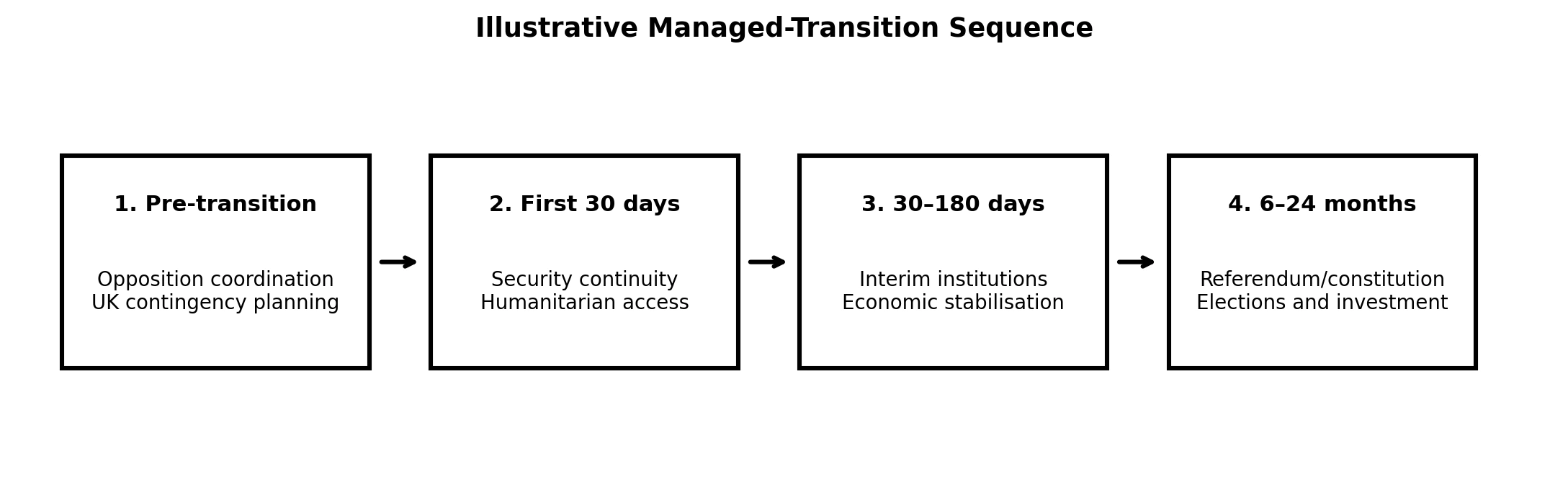
This scenario assumes an organised transition in which coercive institutions fragment or stand aside, essential administrative capacity is preserved, political prisoners are released, transitional justice is bounded by law, and a constituent or referendum process determines the permanent constitutional order. Reza Pahlavi could play a transitional, convening or symbolic role, but durable legitimacy would depend on consent and elections.
Potential advantages for the United Kingdom
Potential UK advantage | Mechanism / condition |
|---|---|
Reduced hostile-state activity | A government seeking normal relations would have incentives to end plots, intimidation and cyber operations in Britain. |
Non-proliferation settlement | A legitimate post-theocratic government could accept intrusive verification and civilian nuclear constraints with greater public credibility. |
Regional peace architecture | Normalisation with Israel and Arab neighbours could broaden the logic of the Abraham Accords; the proposed “Cyrus Accords” is an advocacy concept, not yet a negotiated treaty. |
Freedom of navigation | A government dependent on lawful trade would have strong incentives to keep Hormuz open and reduce maritime coercion. |
Trade expansion | Sanctions relief and legal reform could unlock UK exports in finance, engineering, education, medicine, insurance, energy services and professional services. |
Energy investment | Iran requires major investment in oil, gas, electricity grids, renewables, water and efficiency—areas of UK expertise. |
Human-capital partnership | Large diaspora networks and a highly educated population could support university, technology, medical and entrepreneurial links. |
Lower migration push factors | Improved rights, employment and security could reduce forced migration over time, though early transition may initially increase mobility. |
Human rights and rule of law | Secular constitutional safeguards could improve women’s rights, minority protection, religious freedom and legal predictability. |
Counter-terrorism realignment | Ending support for armed proxies would reduce threats to UK allies and forces. |
Asset recovery and anti-corruption | Transparent recovery of state assets could create lawful reconstruction finance and reduce illicit finance. |
Soft-power gain | Early UK support for a genuinely democratic, Iranian-led process could repair historical mistrust. |
Regional economic integration | Iran could become a transport, energy and manufacturing bridge between Central Asia, the Gulf, Europe and South Asia. |
Environmental cooperation | International finance and expertise could address water stress, air pollution, methane leakage and energy inefficiency. |
Consular normalisation | Reduced hostage diplomacy and improved judicial cooperation would benefit British citizens and dual nationals. |
Disadvantages, transition risks and UK concerns
Risk / disadvantage | Why it matters to the UK |
|---|---|
Legitimacy uncertainty | Diaspora visibility is not a substitute for verified support inside Iran. A constitutional process must be inclusive and internationally credible. |
Security vacuum | Collapse of command structures could expose nuclear sites, missiles, prisons, borders and armouries. |
Elite resistance | IRGC-linked economic and security networks may sabotage transition or form insurgent structures. |
Opposition fragmentation | Monarchists, republicans, ethnic organisations, left groups, liberals and civil-society actors may disagree over leadership and sequencing. |
Revenge and transitional justice | Uncontrolled purges could destroy administrative capacity and reproduce conflict; impunity would also undermine legitimacy. |
Territorial integrity and minority rights | Kurdish, Baluch, Arab, Azeri and other communities require credible participation, language and equality guarantees without coercive homogenisation. |
Foreign-intervention stigma | Association with Israeli or US military action can be used by opponents to challenge sovereignty and legitimacy. |
Immediate economic shock | Bank runs, capital flight, subsidy disruption, currency collapse and strikes may precede recovery. |
Energy interruption | Transition could temporarily reduce oil and gas output, raising global prices and affecting Gulf shipping. |
Migration surge before improvement | Opening borders and insecurity can initially increase departures, family reunification and asylum claims. |
Strong-state autonomy | A prosperous Iran may bargain firmly, favour domestic industry, protect strategic sectors and decline unfavourable contracts. This is normal sovereign behaviour, not inherently a UK loss. |
Gulf balance-of-power anxiety | Saudi Arabia, UAE, Qatar, Bahrain and others may fear rapid Iranian re-emergence; security reassurance and regional institutions would be essential. |
Monarchical symbolism | Parts of Iranian society associate the Pahlavi period with modernisation; others associate it with repression, inequality or foreign dependence. UK actors will expect acknowledgement of both memories. |
Overpromising “Japan of the Middle East” | Development requires rule of law, capital, infrastructure, productivity, water reform and time; slogans can weaken credibility. |
UK historical sensitivity | British involvement in Iranian history means any appearance of selecting Iran’s ruler could be politically toxic. |
5. Scenario C — Unmanaged Collapse or Fragmentation
This scenario must be analysed separately from democratic transition. It includes rapid regime collapse without an agreed authority, military fragmentation, local armed rule, ethnic conflict, foreign intervention or loss of control over strategic sites.
Domain | UK consequence |
|---|---|
National security | Loose missiles, nuclear materials, armed factions, terrorist safe havens and direct pressure for UK military or evacuation operations. |
Energy | Closure or insecurity in Hormuz, damaged infrastructure, tanker insurance spikes and global price shocks. |
Humanitarian | Large internal displacement, refugee movements and pressure on Turkey, the Caucasus, Gulf states and Europe. |
Regional war | Intervention by Israel, Gulf states, Turkey, Russia, Pakistan, the US or non-state groups. |
Crime and trafficking | Expansion of weapons, drugs, people-smuggling and sanctions-evasion networks. |
Economic loss | Destruction of productive assets and a prolonged interruption to trade and investment. |
Political outcome | A new authoritarian regime may emerge more quickly than a functioning democracy because coercive organisations are easier to build than plural institutions.[21] |
6. PESTLE Analysis
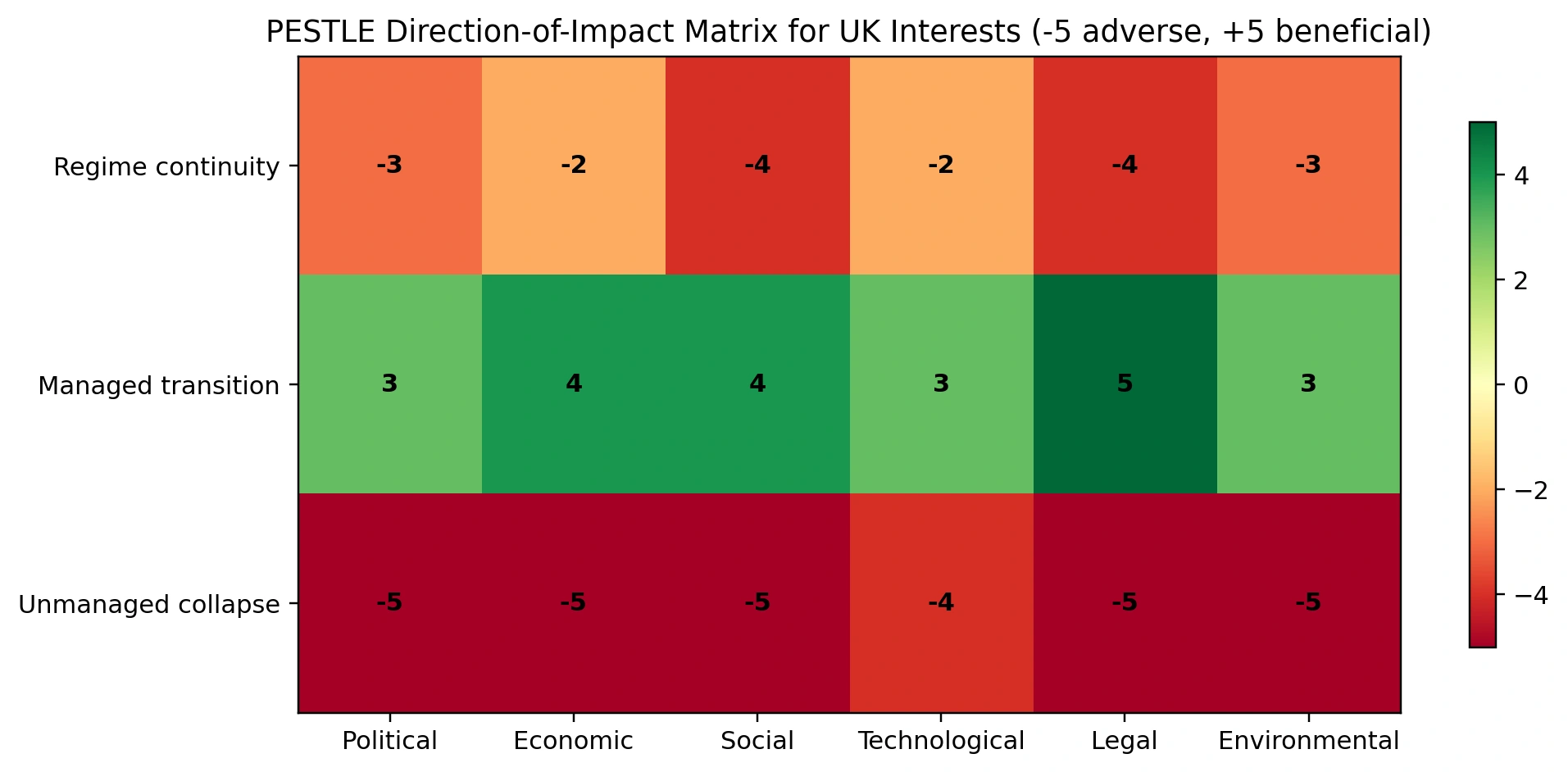
The heatmap gives directional scores only. The detailed assessment below identifies both positive and negative mechanisms.
PESTLE | Scenario | Potential positive | Principal risk |
|---|---|---|---|
Political | Continuity | Existing diplomatic channels; tactical negotiability; no transition shock. | Ideological hostility, factionalism, proxy policy, succession uncertainty, low domestic legitimacy. |
Political | Managed transition | Potential normalisation, popular constitutional process, regional peace architecture. | Contested leadership, foreign-intervention stigma, opposition fragmentation. |
Economic | Continuity | Possible discounted exports and sanctions-for-compliance bargaining. | Sanctions, inflation, weak investment, corruption, low bilateral trade, maritime risk. |
Economic | Managed transition | Sanctions relief, reconstruction, services exports, diaspora capital, energy investment. | Initial currency/banking shock, contract disputes, sovereign industrial policy. |
Social | Continuity | Avoids abrupt social dislocation. | Repression, demographic frustration, brain drain, discrimination and migration push factors. |
Social | Managed transition | Expanded rights, return migration, civil-society growth. | Polarisation, revenge violence, transitional migration surge. |
Technological | Continuity | Retains domestic technical capacity. | Cyber hostility, export controls, isolation, infrastructure decay. |
Technological | Managed transition | Digital modernisation, university partnerships, energy and medical technology. | Cyber sabotage, data loss, skilled-personnel flight during transition. |
Legal | Continuity | Existing legal-administrative machinery. | Arbitrary detention, sanctions risk, weak contract enforcement, politicised courts. |
Legal | Managed transition | Independent judiciary, rights charter, investment law, transitional justice. | Legal vacuum, property disputes, overbroad lustration. |
Environmental | Continuity | Central control can coordinate emergency measures. | Water depletion, pollution, methane leakage, subsidy distortions and weak transparency. |
Environmental | Managed transition | Access to climate finance, water and grid reform. | Reconstruction demand and weak early enforcement may worsen pressures. |
7. SWOT Analysis
A. UK engagement with a managed transition associated with Reza Pahlavi
SWOT element | Assessment |
|---|---|
Strengths | Recognisable international figure; long-standing secular-democratic message; diaspora networks; ability to convene; symbolic link to pre-1979 state continuity; published transition and prosperity concepts. |
Weaknesses | No electoral mandate; decades outside Iran; disputed popularity; limited verified organisation inside the country; divisions among supporters; risk of personality-centred politics; contested historical legacy. |
Opportunities | Managed defection of officials; referendum/constituent process; regional normalisation; sanctions relief; diaspora return; UK commercial and educational partnerships; non-proliferation settlement. |
Threats | Regime repression; assassination or intimidation; foreign military escalation; opposition infighting; ethnic conflict; information warfare; monarchical absolutism accusations; failed transition producing authoritarian restoration. |
B. Islamic Republic continuity from a UK perspective
SWOT element | Assessment |
|---|---|
Strengths | Existing state institutions; coercive control; established diplomatic channels; capacity to sign and administer agreements; control over energy and borders. |
Weaknesses | Low legitimacy, sanctions, economic mismanagement, ideological constraints, factional rivalry, human-rights abuses and exposure to succession crises. |
Opportunities | Verified nuclear settlement; maritime confidence-building; prisoner releases; limited sanctions relief; de-escalation with Gulf states. |
Threats | Renewed war; nuclear breakout; transnational repression; proxy escalation; cyberattack; mass protest; abrupt collapse; Hormuz disruption. |
8. Lewin Force-Field Analysis
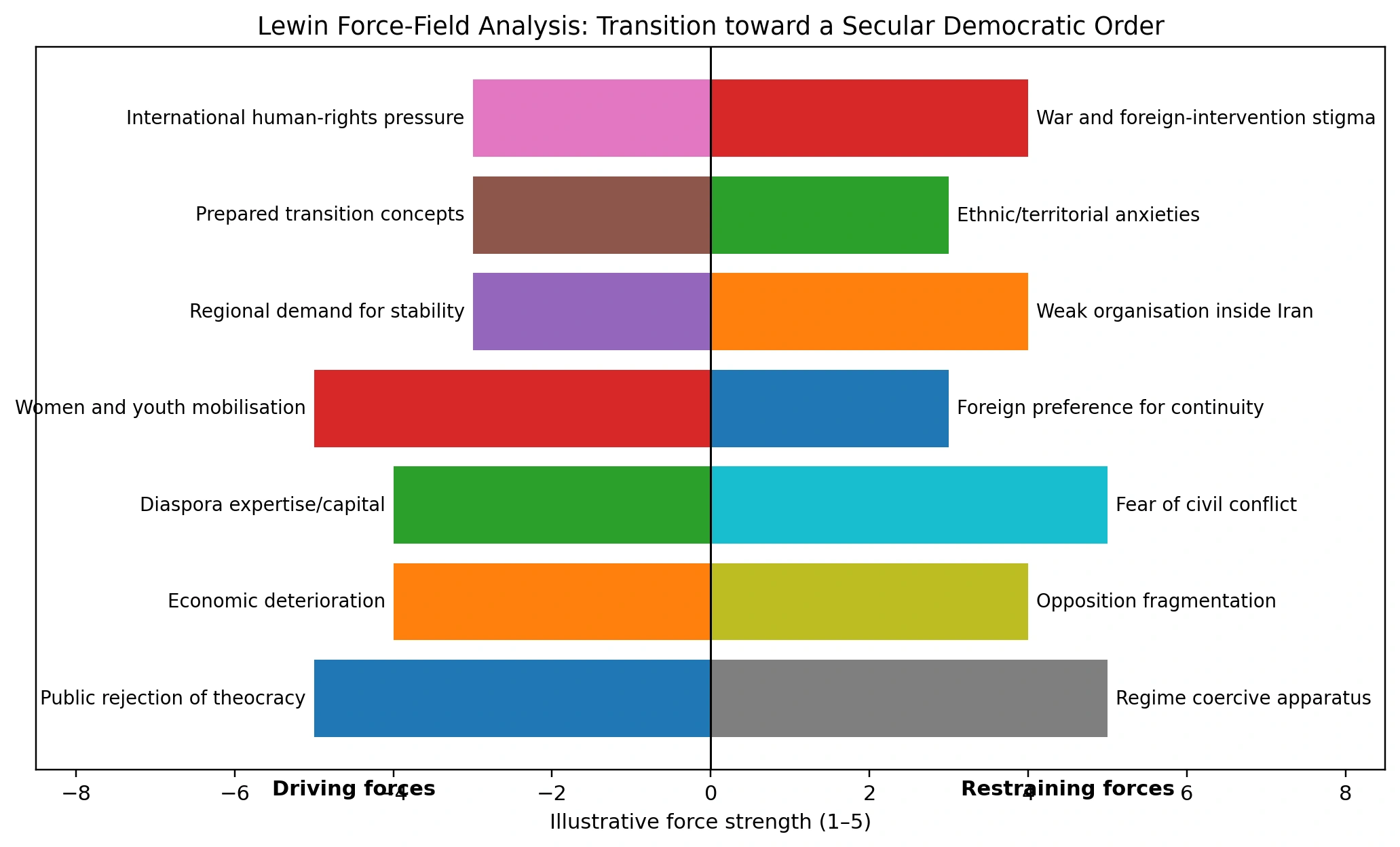
The central practical lesson from Lewin’s model is that adding more pressure for change is insufficient if restraining forces remain intact. A credible transition strategy must reduce fear of chaos, demonstrate institutional continuity, establish plural leadership rules, reassure minorities and Gulf neighbours, and create a lawful path for non-criminal state employees to remain in public service.
Intervention | Operational meaning |
|---|---|
Increase driving force | Document broad social demands; connect diaspora expertise to domestic networks; prepare economic stabilisation; articulate women’s and minority rights; present a credible non-proliferation plan. |
Reduce restraining force | Guarantee no collective punishment; distinguish criminal accountability from institutional continuity; commit to referendum and elections; reject territorial fragmentation; create Gulf security assurances; avoid triumphalist or dehumanising rhetoric. |
Critical balance | Transition becomes more plausible when regime insiders believe defection is safer than repression and ordinary citizens believe change is safer than continuity. |
9. Comparative Scenario Scoring
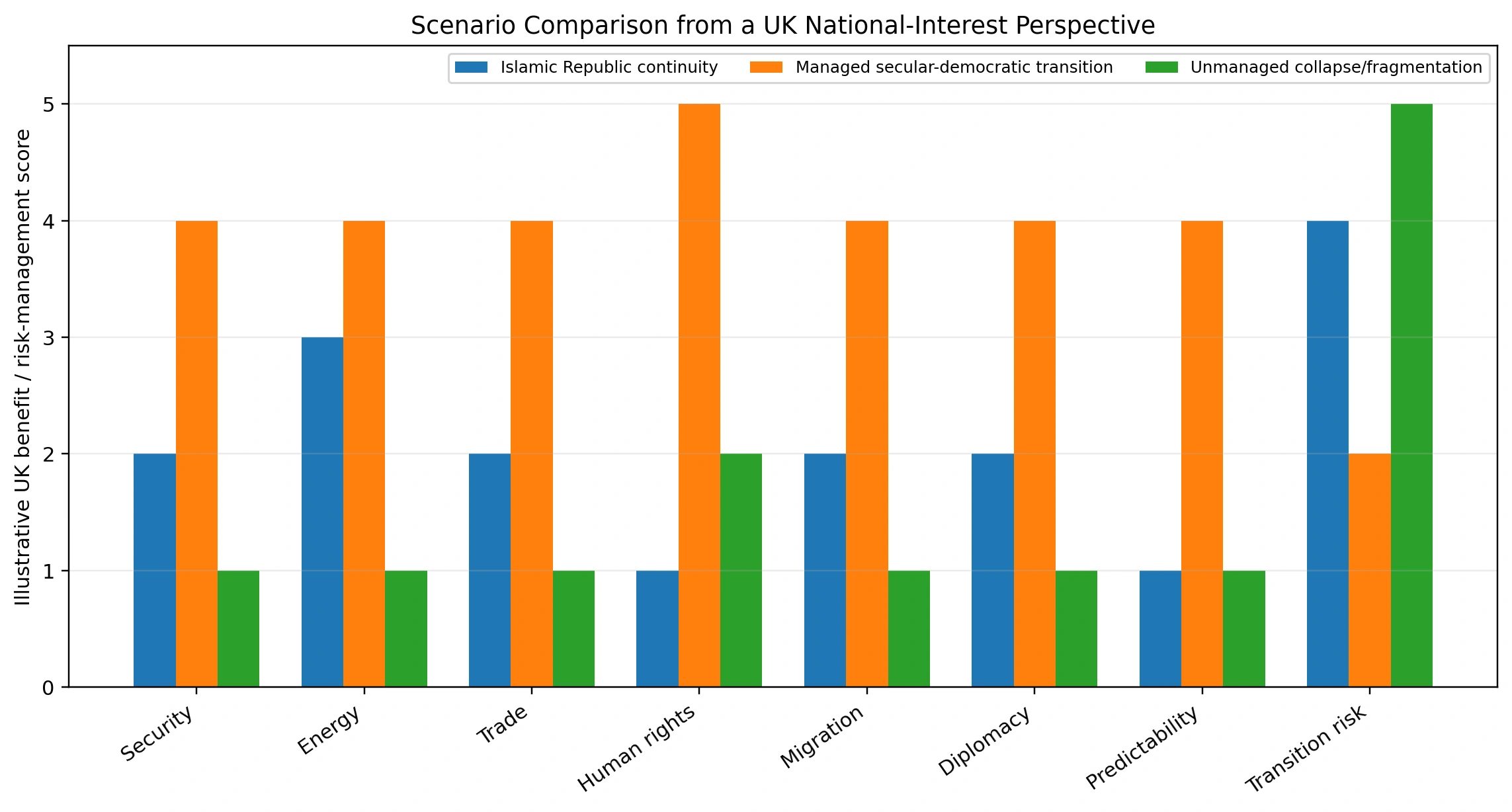
Dimension | Regime continuity | Managed transition | Unmanaged collapse |
|---|---|---|---|
Security | 2 | 4 | 1 |
Energy | 3 | 4 | 1 |
Trade | 2 | 4 | 1 |
Human rights | 1 | 5 | 2 |
Migration | 2 | 4 | 1 |
Diplomacy | 2 | 4 | 1 |
Predictability | 1 | 4 | 1 |
Transition risk | 4 | 2 | 5 |
Interpretation: the managed-transition scenario scores best on long-run UK interests but only when the transition is genuinely managed. The continuity scenario performs somewhat better than collapse on immediate institutional continuity, but poorly on rights, security and predictability. Unmanaged collapse is worst across nearly every category.
10. Stakeholder Map for UK Engagement
Stakeholder | Primary concern | Best engagement frame |
|---|---|---|
UK Government / FCDO | De-escalation, non-proliferation, nationals, regional stability, lawful diplomacy. | Present evidence-based transition safeguards; avoid requests that Britain “choose” Iran’s ruler. |
Home Office / security services | Iran-linked threats, asylum, proscription, public order. | Provide documented threat information; separate peaceful activism from harassment or incitement. |
Parliamentarians | Constituency concerns, human rights, sanctions, foreign policy. | Use concise briefings with specific asks, evidence and acknowledgement of risks. |
Local councillors | Community cohesion, events, policing, hate incidents. | Focus on lawful civic participation, safety and anti-discrimination. |
Media | Verification, balance, conflict, public relevance. | Use precise terminology; disclose advocacy role; distinguish facts, scenarios and aspirations. |
Trade and professional bodies | Sanctions compliance, future market, reputational risk. | Discuss post-transition opportunities conditionally, not as guaranteed contracts. |
Gulf embassies and communities | Balance of power, shipping, sectarian tension. | Emphasise non-aggression, sovereignty, trade and regional security institutions. |
Iranian diaspora groups | Representation, identity, historic grievances. | Adopt plural rules; reject threats and exclusion; invite republican, minority and civil-society perspectives. |
Human-rights organisations | Executions, prisoners, women, minorities, accountability. | Commit to universal rights and lawful transitional justice, including scrutiny of all political camps. |
Academia / think tanks | Evidence quality, scenarios, institutional design. | Invite peer review and publish assumptions, sources and uncertainty. |
11. Recommended UK-Facing Argument Architecture
Step | Content |
|---|---|
1. Start with common UK interests | No nuclear weapon; no attacks in Britain; open shipping routes; regional stability; human rights; controlled migration; lawful trade. |
2. Avoid historical determinism | British colonial experience does not create perfect knowledge of Islamist politics, and US inexperience alone does not explain policy failure. |
3. State the democratic principle | The UK should not appoint Iran’s future ruler. It should support Iranian self-determination and an inclusive constitutional process. |
4. Present Reza Pahlavi as a transition proposition | Explain his convening role, secular-democratic claims and planning initiatives, while acknowledging contested support and the need for a mandate. |
5. Address the strongest objection | Demonstrate how the plan avoids Iraq-, Libya- or Syria-style institutional collapse. |
6. Reassure Gulf partners | Commit to non-aggression, navigation, nuclear restraint, minority rights and regional economic integration. |
7. Replace slogans with measurable commitments | Timelines for political prisoners, media freedom, interim law, central-bank continuity, oil security, elections and international monitoring. |
8. Use conditional commercial language | A future democratic Iran could create major opportunities, subject to law, sanctions relief, governance and market conditions. |
9. Protect credibility | Do not claim that most Iranians support one constitutional form without robust and current evidence. |
10. Separate advocacy from analysis | Label preferences openly and preserve the distinction between verified facts, scenarios and desired outcomes. |
12. Questions UK Counterparts Are Likely to Ask
Likely question | Credible response |
|---|---|
Who authorised you to speak for Iranians? | Answer as a civic advocate, not a sole representative; cite networks and disclose limits. |
What evidence shows Reza Pahlavi’s support inside Iran? | Use cautious evidence; acknowledge that repression prevents normal polling and that support is contested. |
Would monarchy be imposed? | State that constitutional form must be selected through a free, monitored process. |
How would you prevent a security vacuum? | Present continuity plans for ministries, police, borders, nuclear sites, utilities and food supply. |
What happens to IRGC personnel? | Differentiate leaders and perpetrators from conscripts, technicians and personnel not implicated in crimes; use vetting and reintegration. |
How would minorities be protected? | Offer enforceable equality, language/cultural rights, decentralisation debate, independent courts and inclusion in transition bodies. |
Would Iran recognise Israel? | State the advocated policy precisely; do not imply authority to bind a future elected government. |
Would oil contracts be honoured? | Commit to transparent legal review, continuity of lawful contracts and anti-corruption standards. |
What is the UK being asked to do now? | Examples: engage a broad opposition spectrum; protect activists; enforce sanctions and state-threat laws; support internet access; prepare humanitarian and institutional contingencies. |
Could transition increase asylum temporarily? | Yes. Explain early humanitarian contingency planning and the long-run strategy to reduce forced displacement. |
13. Risk Register and Mitigations
Risk | Severity | Mitigation |
|---|---|---|
Security vacuum | Very high | Preserve command for essential security; international monitoring of strategic sites; pre-agreed emergency authority. |
Civil conflict / separatism | Very high | Inclusive interim council; territorial-integrity commitment; minority guarantees; local administration continuity. |
Economic collapse | High | Central-bank continuity; emergency liquidity; food/fuel plans; sanctions roadmap; diaspora technical teams. |
Revenge violence | High | Immediate prohibition; protected detention; independent prosecutors; truth commission; no collective punishment. |
Opposition legitimacy crisis | High | Transparent selection rules; time-limited mandates; referendum; monitored elections. |
Gulf intervention or fear | High | Regional non-aggression declaration; maritime guarantees; diplomatic contact before transition. |
Nuclear proliferation insecurity | Very high | Secure sites and personnel; IAEA access; chain-of-custody protocols. |
Disinformation | High | Verified communications; multilingual public information; independent media safeguards. |
Humanitarian displacement | High | UN coordination; protected corridors; border agreements; rapid restoration of services. |
Authoritarian relapse | High | Separation of powers; civilian control; term limits; independent judiciary and media. |
14. Model Talking Points
The choice is not between a predictable Islamic Republic and a risk-free democratic Iran. The real comparison is between recurrent instability under the present system, a prepared transition, and unmanaged collapse.
We do not ask Britain to select Iran’s ruler. We ask Britain to support the right of Iranians to choose a secular, democratic constitutional order through a credible process.
Reza Pahlavi should be assessed on whether he can help deliver an inclusive, time-limited and lawful transition—not on dynastic title alone.
A future Iran must reassure its Arab neighbours that national strength will be used for trade, development and collective security rather than domination.
British commercial opportunity is a secondary argument. The primary case is national security: no nuclear weapon, no state-sponsored threats in Britain, free navigation and a stable regional order.
Any transition plan must explain the first 24 hours, first 30 days and first six months: command, food, fuel, currency, hospitals, borders, prisons, nuclear sites and public communication.
15. Limitations
Iran is an opaque and rapidly changing political system. Reliable public-opinion measurement is constrained by repression, conflict, internet restrictions and diaspora selection effects. The paper therefore does not quantify support for monarchy, republicanism or any individual leader. It also does not assume that the UK seeks to preserve the Islamic Republic for energy advantage; that proposition is treated as a hypothesis requiring evidence. Scenario scores are illustrative and should be updated after major political, military or economic developments.
16. Conclusion
For the United Kingdom, a weakened Islamic Republic may offer short-lived transactional utility, especially when it implements a verifiable security agreement. It simultaneously creates persistent national-security, sanctions, human-rights and regional-instability costs. A well-managed transition to secular democracy offers materially larger long-term benefits, but only if advocates can demonstrate institutional continuity, broad legitimacy, minority protection, non-proliferation and restraint toward neighbouring states. The central persuasive task for Lion and Sun activists is therefore to make democratic transition appear not merely morally desirable, but administratively safer and strategically more predictable than either clerical continuity or chaotic collapse.
References
[1] UK Prime Minister, “PM statement on Iran,” 28 February 2026, GOV.UK.
[2] UK Prime Minister, “Prime Minister’s Oral Statement on Iran,” 2 March 2026, GOV.UK.
[3] UK Government, “Joint E4 Leaders’ Statement on the US-Iran peace deal,” 14 June 2026.
[4] G7, “Leaders’ statement on geopolitical issues,” 17 June 2026.
[5] Foreign, Commonwealth & Development Office, “UK sanctions Iran-linked criminal group that publicly claimed responsibility for recent attacks on Jewish locations,” 13 July 2026. Source
[6] House of Commons Library, Iranian state threat activities in the UK, Research Briefing CBP-10413, 16 June 2026.
[7] House of Lords Library, Transnational repression in the UK: Joint Committee on Human Rights report, 18 February 2026.
[8] UK Government, National Security (State Threats) Act 2026: factsheet, 17 July 2026.
[9] Reza Pahlavi, official statements and transition-related materials, 2026.
[10] Reuters, “Reza Pahlavi speaks to Reuters about Iran’s future,” 28 July 2026.
[11] Reza Pahlavi / associated transition advocacy, Iran Prosperity Project materials, 2024–2026.
[12] The New Yorker, “The Distant Promise of Iran’s Would-Be King,” 2026 (critical assessment).
[13] UK Department for Business and Trade, Iran: Trade and Investment Factsheet, 31 July 2026.
[14] UK Government, “Iran, the Middle East and UK energy: factsheet,” 6 March 2026.
[15] US Energy Information Administration, analysis of oil and LNG flows through the Strait of Hormuz (latest available editions).
[16] UK Government, Iran nuclear sanctions statutory guidance, updated 1 May 2026.
[17] World Bank, Islamic Republic of Iran country overview and Macro Poverty Outlook, April 2026.
[18] World Bank, Global Economic Prospects, June 2026.
[19] World Bank, MENAAP Economic Update, 2026.
[20] UNHCR, Iran Operational Data Portal and Global Trends 2025, updated 2026.
[21] Gard-Murray, A. and Bar-Yam, Y., “Complexity and the Limits of Revolution,” 2012.
[22] UK Parliament, evidence and debates on UK policy toward Iran and Iran’s regional role.
[23] UK Government, Government Response to the Intelligence and Security Committee report on Iran, 4 September 2025.
[24] United Nations Universal Declaration of Human Rights, 1948.
[25] UK Global Human Rights Sanctions Regulations 2020 (“Magnitsky-style” sanctions framework).
Appendix A — Suggested One-Page Meeting Checklist
Item | Requirement |
|---|---|
Objective | One specific outcome: meeting, written question, briefing circulation, safeguarding action, or policy clarification. |
Evidence | Three current official facts; one independent corroboration; no unsupported polling claim. |
Democratic safeguard | Referendum/constituent process, secularism, elections, minority rights and independent courts. |
Transition safeguard | Security continuity, non-proliferation, utilities, banking, humanitarian access and no collective punishment. |
UK interest | State-threat reduction, Hormuz, nuclear restraint, trade, migration and regional stability. |
Acknowledged risk | Name the strongest counterargument and the mitigation. |
Language | Avoid “Britain must install”; use “engage,” “prepare,” “protect,” “support self-determination,” and “condition assistance.” |
Follow-up | Send a two-page brief with sources and precise action requested. |